
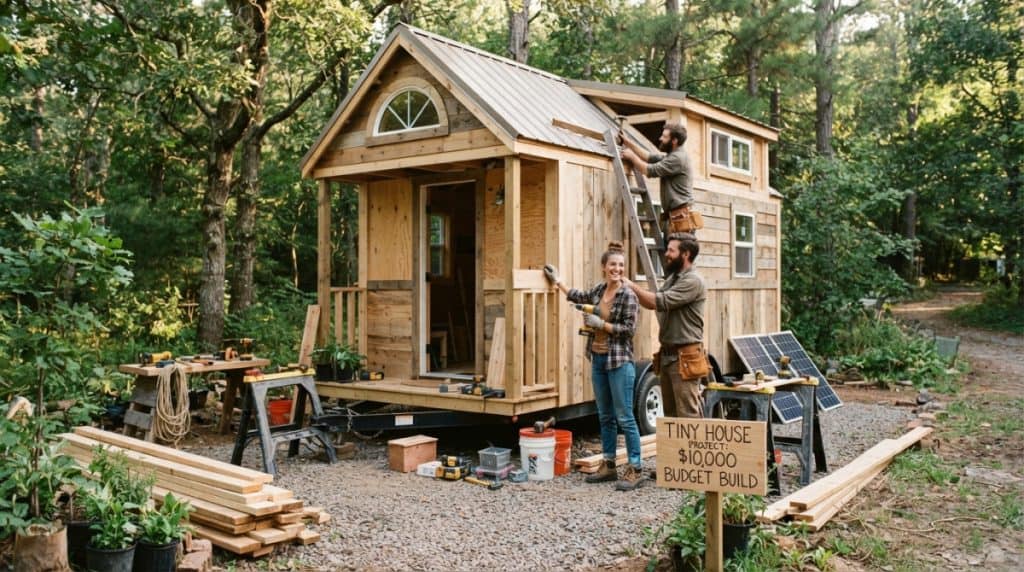
The tiny house movement has captured the imagination of millions. It promises a life of financial freedom, minimalism, and a smaller carbon footprint. For many, the appeal isn’t just about downsizing space; it’s about downsizing debt. We see beautiful, cedar-clad cabins on wheels in glossy magazines and wonder, “Could I do that?”
Inevitably, the question arises: Can you actually build a tiny house for $10,000?
The short answer is: Yes, but with major caveats. It is not easy, it will not look like the Pinterest-perfect homes you see on Instagram, and it will require a level of DIY skill and scrounging that borders on the obsessive. However, if you are willing to redefine what a “house” is and get your hands dirty, $10,000 is a viable starting point for a very basic shelter.

Here is the realistic breakdown of how to build a tiny house on a $10,000 budget, what you will have to sacrifice, and the hidden costs you need to watch out for.
The $10,000 Reality Check
Where the Budget Breaks: The “Hidden” Costs
Related Reading
What Does a Shed Need to Become a Legal Tiny House?
How Much Does it Cost to Build a Tiny House?
Can You Legally Turn a Shed into a House?
Tiny House Plans: 15 Amazing Designs You’ll Wish You Found Sooner
10 Tips for Turning a Shed into a Tiny House
Before we grab a hammer, we need to manage expectations. Most professional tiny house builds cost between $30,000 and $80,000. A $10,000 budget is roughly 15% of the average cost.
To hit this number, you must adhere to three rules:
- You must do 100% of the labor yourself.
- You must use reclaimed, salvaged, or budget-grade materials.
- You must simplify the design to the absolute basics.
If you are paying a contractor, buying new materials from Home Depot, or installing high-end appliances, your budget will be blown before the framing is finished.
The Budget Breakdown
To make $10,000 work, every dollar must be accounted for. Here is a realistic allocation of funds for a DIY build (assuming an 8×20 foot shell).
- The Trailer (Foundation): $2,000 – $3,000
This is the one area where you should not skimp. The foundation of a tiny house on wheels is a trailer. A brand new, custom-built trailer from a specialized manufacturer can cost $5,000 to $8,000. That is half your budget.

**The $10k Solution:** You must buy a used flatbed trailer. Look for a used car hauler or utility trailer with a heavy-duty axle. You will likely need to modify it (adding subflooring and insulation), but a used trailer can be found for $2,000 to $3,000 if you hunt for deals. Warning: Ensure the trailer has a clear title and can handle the weight.
- Framing and Sheathing: $2,000
Wood prices fluctuate wildly, but for a small structure, you can keep this low by using standard dimensional lumber (2x4s) rather than high-end timber.
The $10k Solution: Use “cull” lumber (wood that is warped or has knots) from big box stores for blocking and non-structural elements. For the exterior sheathing, use standard OSB (Oriented Strand Board) rather than plywood. It’s ugly, but it’s cheap and structural.
- Insulation and Roofing: $1,000
You need to stay warm and dry. Spray foam is the gold standard but is expensive. Fiberglass batts are cheap but require careful installation to avoid moisture issues.
The $10k Solution: Use rigid foam board for the floor and fiberglass batts for the walls. For the roof, look for “drip edge” and metal roofing panels that are discounted due to cosmetic damage (scratches or wrong colors). Metal roofing is often cheaper than asphalt shingles in the long run and easier to install on a DIY build.
- Windows and Doors: $1,000
New windows are incredibly expensive. A single high-end double-pane window can cost $500.
**The $10k Solution:** **Habitat for Humanity ReStore is your best friend.** You can often find high-quality double-pane windows and exterior doors for 50-80% off retail. The catch? You have to design your house around the windows you find, not the other way around. Mismatched windows are a hallmark of the $10k build.
- Exterior Siding: $800
Cedar shake is out of the question.
The $10k Solution: Use corrugated metal siding (often used for agricultural buildings). It is inexpensive, durable, and gives a modern, industrial look. Alternatively, use “board and batten” made from cheap pine boards, or check Craigslist for leftover siding from other construction jobs.
- Electrical and Plumbing: $1,200
You need power and water. Professional electricians and plumbers charge premium rates.

The $10k Solution: You must DIY this. However, you must also pull permits and get inspections. If you are off-grid, you can use a simple solar setup (Renogy kits are affordable) and a composting toilet to avoid complex plumbing. If you are on-grid, use standard RV components for your electrical panel (converter/charger) and PEX piping for plumbing. PEX is cheap and easy to install.
- Interior Finishes: $1,000
This includes flooring, paint, and cabinetry.
The $10k Solution: Skip the hardwood floors. Use vinyl plank flooring or even painted plywood. For cabinets, build them yourself using plywood and paint them. Use “oops” paint from the hardware store for the walls. For countertops, use butcher block from IKEA or laminate remnants.
Where the Budget Breaks: The “Hidden” Costs
If you spend exactly $10,000 on materials, you are still going to run into trouble. Here is where the dream often dies:
- Tools: Do you own a framing nailer, a circular saw, a miter saw, and a level? If not, you need to rent or buy them. This can eat $500-$1,000 of your budget.
- The “Misc” Tax: Screws, nails, caulk, adhesives, tape, and sandpaper. These small items add up to hundreds of dollars very quickly.
- The Toilet: A composting toilet (like Nature’s Head) costs $1,000. A standard RV toilet is cheaper but requires a black water tank and dumping fees. A bucket with sawdust is free.
- The Fridge: A standard mini-fridge is $150. A 12-volt marine fridge is $800. Buy the cheap one.
- Appliances: You cannot afford a washer/dryer or a full oven. You will be using a camp stove and a toaster oven.
- Safety Gear: Respirators, safety glasses, and gloves. Do not skip these.
The “Free” Materials Strategy
To make the $10k budget work, you have to become a hunter-gatherer of building materials. Your weekends will be spent scrolling Craigslist “Free” sections and Facebook Marketplace.
- Pallets: You can disassemble wooden pallets for free wood. It is labor-intensive, but the wood is often high-quality hardwood. Use it for interior accent walls or flooring (if you have the patience to sand it).
- Reclaimed Barn Wood: If you live in a rural area, look for old barns being torn down. The wood is often free for the taking if you haul it away.
- Free Dirt: For landscaping, use fill dirt from construction sites. (Just make sure it’s clean).
The Design Constraints
With a $10,000 budget, you cannot have a loft bedroom with a staircase. You cannot have a full-sized shower. You cannot have a washer/dryer.

Your design must be a “dry cabin” or a “camping trailer” in essence. You will likely be using a composting toilet, a bucket shower, and a loft bed accessible by a ladder. The kitchen will be a small counter with a camp stove. Your “closet” will be a rod under the loft.
The “Sweat Equity” Factor
It is vital to understand that the $10,000 price tag does not include the value of your time. If you value your time at $20 an hour, and it takes you 500 hours to build the house, you have effectively “spent” $10,000 in labor.
Building a tiny house is a second job. It will take months. You will be tired. You will make mistakes. You will likely have to redo the plumbing or the wiring because you watched a YouTube video and got it wrong the first time.
Is It Worth It?
So, can you build a tiny house for $10,000?
Yes. But you have to be honest with yourself about your skills and your expectations.
If you have carpentry experience, a place to build, a truck to haul materials, and a willingness to live with mismatched windows and a composting toilet, you can absolutely build a shelter for $10,000.
However, if you are looking for a turnkey “Tiny Home” with a flush toilet, a shower, a washer, and a beautiful cedar interior, you need to triple your budget to $30,000.
The $10,000 tiny house is not a luxury home. It is a statement of intent. It is a shelter that says, “I value experiences over things.” It is a roof over your head that you own outright. And for many people, that is worth more than a fancy kitchen.
If you are ready to work for 6 months straight, live in a construction zone, and learn every trade from framing to plumbing, the $10k dream is alive and well. Just remember to bring a friend, a lot of patience, and a healthy dose of reality.