
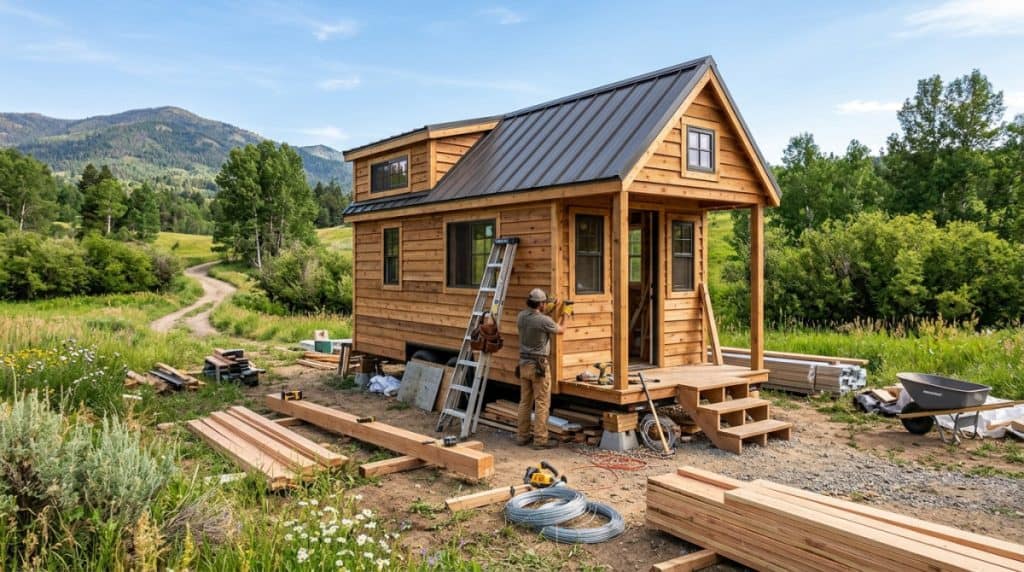
The tiny house movement has captured the imagination of millions. It promises a life free from the shackles of a thirty-year mortgage, a smaller carbon footprint, and the freedom to travel with your home in tow. But beneath the romanticized Instagram photos of minimalist lofts and cedar-shingled exteriors lies a pressing question for every aspiring tiny dweller: How much does it actually cost to build a tiny house?
The short answer is that there is no single price tag. A tiny house can cost anywhere from $10,000** for a DIY shed conversion to over **$150,000 for a luxurious, professionally built park model. The variables are vast, ranging from the level of finish to whether you plan to build it yourself or hire a crew.

In this comprehensive guide, I will break down the costs associated with building a tiny house, explore the different paths you can take, and uncover the hidden expenses that often catch first-time builders off guard.
Let’s Go over the Factors of Your Tiny House Cost
Quick Navigation Menu
The Three Tiers of Tiny House Costs
Tiny House Cost Breakdown: Where Does the Money Go?
Tiny House Hidden Costs: What They Don’t Tell You
DIY vs. Professional: The Time-Money Cost Trade-off
Tiny House Cost Per Square Foot: Tiny vs. Traditional
The “Off-Grid” Premium Added Tiny House Cost
4 Strategies to Save Money on Your Tiny House Costs
Summary: Realistic Tiny Home Budget Estimates
Related Reading
Can You Legally Turn a Shed into a House?
Tiny House Plans: 15 Amazing Designs You’ll Wish You Found Sooner
10 Tips for Turning a Shed into a Tiny House
The Three Tiers of Tiny House Costs
To understand the financial landscape, it helps to categorize tiny house builds into three distinct tiers based on who does the work and the quality of the materials.
1. The DIY Route ($10,000 – $30,000)
This is the “American Dream” approach—building your own home with your own hands. In this scenario, you are the general contractor and the labor force.
-
Pros: You save significantly on labor costs, which typically make up 50% of a build.
-
Cons: It requires immense time (often 1,000+ hours), specialized skills, and tool rentals. Mistakes can be costly.
-
Cost Drivers: Material quality. Using reclaimed wood, Craigslist finds, and basic appliances keeps the cost near $10k. Using new, high-end materials pushes it toward $30k.
2. The Shell or “Barn-Raiser” Route ($30,000 – $60,000)

In this model, you hire a professional to build the “shell” (the trailer, framing, roofing, windows, and siding) and you finish the interior yourself.
-
Pros: You ensure the structure is safe and weather-tight (the hardest part) while saving money on the interior finish work.
-
Cons: You still need DIY skills for plumbing and electrical, and coordinating the transition from builder to owner can be tricky.
3. The Professional Turnkey Route ($60,000 – $150,000+)
Here, you hire a reputable tiny house company to build a move-in-ready home.
-
Pros: Peace of mind, warranty, high-quality craftsmanship, and professional design.
-
Cons: The price tag. High-end professional builds can rival the cost per square foot of a traditional luxury home.
Tiny House Cost Breakdown: Where Does the Money Go?
To understand why a tiny house costs what it does, we need to look at the individual components. Even though the house is small, the systems inside it are full-scale.
1. The Trailer (Foundation)
Unlike a traditional home, a tiny house on wheels needs a foundation that can handle highway speeds.
-
Cost: $4,000 – $15,000
-
Details: You cannot use a standard utility trailer. You need a custom-built trailer with a heavy-duty frame, brakes, and proper weight distribution. A professional, custom trailer with a 10k-14k lb capacity will start around $6,000 and go up from there.
2. Materials and Framing
-
Cost: $10,000 – $20,000
-
Details: Lumber prices fluctuate wildly. For a 24-foot trailer, you are looking at significant framing costs. Insulation is another factor; spray foam is more expensive than fiberglass but essential for a tiny house to prevent condensation and mold.
3. Windows and Doors
-
Cost: $3,000 – $8,000
-
Details: Tiny houses rely on natural light to feel spacious. High-quality, double-paned windows are expensive. A custom entry door (often glass-paneled) can cost $1,000 alone.
4. Utilities (The “Nervous System”)

This is where costs often balloon. You are packing a full house’s worth of systems into a small space.
-
Electrical: $2,000 – $5,000. You need a breaker box, wiring, and potentially a solar setup.
-
Plumbing: $2,000 – $6,000. PEX piping, a water heater, and a shower/toilet.
-
Propane/Gas: $1,000 – $2,000. For heating and cooking.
5. Appliances and Fixtures
-
Cost: $3,000 – $10,000
-
Details: You need a fridge, stove, sink, and toilet. Composting toilets can cost $1,000+, while incinerating toilets can cost $4,000. A tankless water heater is another $1,000.
6. Interior Finish
-
Cost: $5,000 – $15,000
-
Details: This is the aesthetic layer. Hardwood flooring, custom cabinetry, tile work, and lighting. This is where you can easily overspend.
Tiny House Hidden Costs: What They Don’t Tell You
When budgeting, most people calculate the cost of lumber and nails. However, building a tiny house involves a web of peripheral expenses that are easy to overlook.
Land and Parking
This is the biggest variable. Where will you put it?
-
Buying Land: Zoning laws often prohibit living in a tiny house full-time on vacant land. You may need to buy land zoned for RVs or residential use. This can cost anywhere from $10,000 to $100,000+.
-
Renting Space: Renting a spot in someone’s backyard or an RV park can cost $200 – $800 per month.
Tools and Equipment
If you are doing it yourself, you need tools. While many DIYers own basic tools, building a house requires specialized equipment.
-
Cost: $1,000 – $3,000
-
Details: Nail guns, miter saws, scaffolding, and safety gear.
Insurance and Permits

-
Trailer Registration: You need to register the trailer as a vehicle.
-
Building Permits: Some municipalities require permits for tiny houses, even if they are on wheels.
-
Insurance: Insuring a DIY tiny house can be difficult and expensive.
The “Mistake Tax”
Every DIY builder makes mistakes. Buying the wrong size window, cutting a beam incorrectly, or installing plumbing that freezes. It is wise to keep a 10-15% contingency fund for these errors.
DIY vs. Professional: The Time-Money Cost Trade-off
When deciding on your budget, you must calculate the value of your time.
A professional builder can finish a tiny house in 4 to 8 weeks. They have jigs, templates, and crews that work simultaneously on electrical, plumbing, and framing.
A DIY builder, working weekends and evenings, may take 6 months to 2 years to finish. During this time, you are likely paying rent or a mortgage elsewhere.
Scenario: If you spend 1,000 hours building a house and save $30,000 in labor costs, you are effectively paying yourself $30/hour. However, if you take a year off work to build it, you lose a year of salary. You must weigh the “sweat equity” against the opportunity cost of your time.
Tiny House Cost Per Square Foot: Tiny vs. Traditional
People are often shocked to learn that tiny houses cost more per square foot than traditional homes. A standard home might cost $150–$200 per square foot to build. A tiny house often costs $300–$500 per square foot.
Why? Because the expensive parts of a house—the kitchen, bathroom, and roof—don’t shrink proportionally. A tiny house still needs a $1,000 fridge, a $2,000 shower, and a $5,000 roof, but those costs are spread over 200 square feet instead of 2,000.
However, the total cost is what matters. You are paying a premium per square foot to own a home outright with zero debt.
Financing Your Tiny House
Securing a loan for a tiny house can be challenging. Traditional mortgages usually require a permanent foundation and a minimum square footage. Here are the common paths:
-
Cash: The most common method. Many tiny house owners sell their current homes or downsize drastically to pay in cash.
-
RV Loans: If your tiny house is certified as an RV (meets ANSI standards), you may qualify for an RV loan. Rates are higher than mortgages.
-
Personal Loans: Unsecured personal loans are an option for smaller amounts, but interest rates can be high.
-
Builder Financing: Some high-end tiny house builders offer in-house financing.
The “Off-Grid” Premium Added Tiny House Cost
If you intend to live off-grid, add $10,000 to $30,000 to your budget.
-
Solar Power: A robust solar setup with lithium batteries and an inverter can cost $10k-$20k.
-
Water Collection: Rainwater catchment systems, filtration, and storage tanks.
-
Composting/Incinerating Toilet: Managing waste without a sewer connection requires specialized equipment.
While off-grid living reduces monthly utility bills, the upfront cost is substantial.
4 Strategies to Save Money on Your Tiny House Costs
If your budget is tight, consider these cost-saving measures:
1. Buy Used
Many people start a tiny house project with grand dreams, only to sell the partially finished shell or trailer when life gets in the way. You can often find trailers or completed shells on Facebook Marketplace or Tiny House Listings for a fraction of the new cost.
2. Use Reclaimed Materials
Reclaimed barn wood, old doors, and repurposed industrial fixtures can add character and save thousands. However, be careful with insulation and structural materials—never skimp on the “envelope” of the house.
3. Keep it Simple
Avoid complex roof lines, custom curved walls, or intricate tile work. A simple gable roof and standard square windows are much cheaper and easier to install.
4. Skip the Propane
All-electric tiny houses are becoming more popular. They simplify the build (no gas lines) and can be powered by a robust solar system if you plan to be off-grid.
The Tiny House Resale Value
One of the benefits of a tiny house is that they tend to hold their value well. Because the market is niche but passionate, a well-built tiny house can often sell for what you paid to build it (or even more, if you built it yourself).
If you build for $30,000 and sell for $50,000, your “DIY labor” was actually a profitable investment.
Summary: Realistic Tiny Home Budget Estimates
To give you a final snapshot, here is what your money buys you in today’s market:
-
$10,000 – $20,000: A bare-bones, DIY shed-style build. Likely no plumbing or electricity, or very basic systems. Often requires significant sweat equity and used materials.
-
$30,000 – $50,000: A solid DIY build. You buy a new trailer and new materials but do all the labor. Includes full plumbing and electrical.
-
$60,000 – $80,000: A professionally built “entry-level” tiny house. High-quality construction, standard finishes, fully turnkey.
-
$100,000+: A luxury tiny house. Custom cabinetry, high-end appliances, complex rooflines, off-grid solar systems, and premium finishes.
Conclusion
So, how much does it cost to build a tiny house? The answer is a reflection of your resources. If you have more time and skill than money, you can build a home for the price of a used car. If you have more money than time, you can buy a bespoke, movable castle for the price of a luxury SUV.
The most important step is to create a detailed budget before you buy a single 2×4. Be honest about your skills, account for the hidden costs like land and tools, and always, always add a contingency fund.
A tiny house is not just a financial transaction; it is a lifestyle choice. By understanding the costs upfront, you can ensure that your transition to tiny living is a dream come true, not a financial nightmare.