
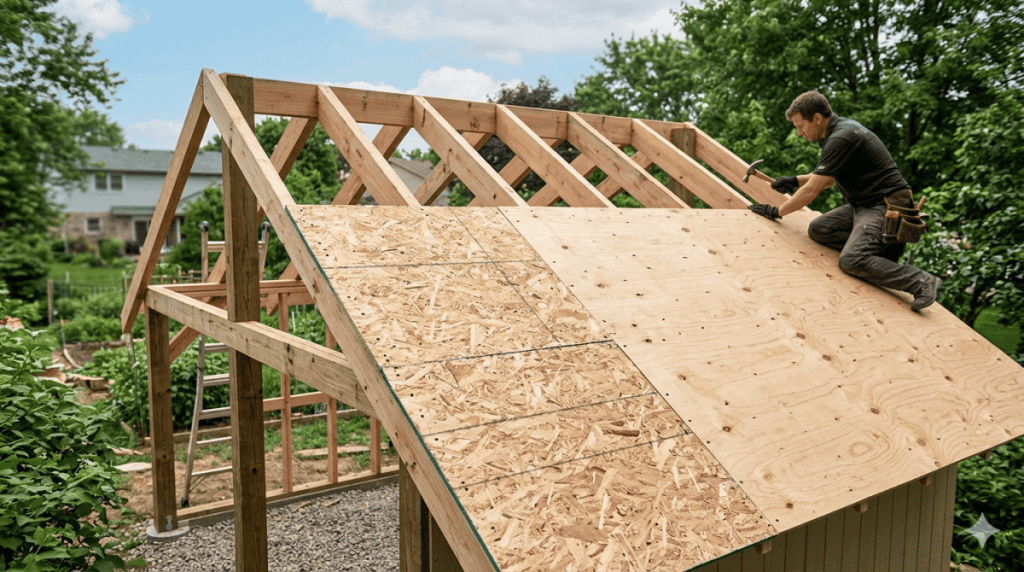
You’ve leveled the concrete blocks, squared the floor frame, and raised the walls. Now comes the moment where many DIY shed builders freeze up: the roof. You have the rafters cut and spaced, but you need a solid nailing surface for the shingles. You walk down the lumber aisle at the big box store and face the great philosophical debate of backyard builders: OSB or Plywood?
At first glance, they look similar. Both are sheets of wood composite. Both are roughly the same price (though that fluctuates wildly with the lumber market). Both will technically hold up your asphalt shingles.
But technically correct is not the same thing as right.
Choosing the wrong sheathing for a shed roof can lead to sagging, “nail pops,” edge warping, and even catastrophic failure in bad weather. Unlike your home, your shed is often unheated, unventilated, and exposed to humidity from below as well as rain from above.
In this 2,500-word guide, I will strip away the marketing hype and look at the cold, hard physics of the shed environment. By the end, you will know exactly which panel to buy, why it matters, and how to install it so your grandchildren are still using that shed fifty years from now.
Quick Navigation Menu
OSB vs Plywood for a Shed Roof
How Does OSB vs Plywood React to These 3 Roof Issues
OSB vs Plywood on Shed Roof The Cost Factor
The “Shed Specific” Variables of OSB and Plywood
Edge Swelling OSB vs Plywood (Do Not Ignore This)
Do I Need H-Clips OSB vs Plywood
OSB and Plywood Grading Stamps: What to Look For
OSB vs Plywood Professional Builder’s Verdict: Which is Better?
The Ultimate Recommendation of OSB or Plywood for Roofing
Step-by-Step: Installation Tips for Your Chosen Material
OSB vs Plywood for a Shed Roof
Before we declare a winner, let’s look under the hood of these two engineered wood products. Understanding how they are made explains why they behave differently on a roof.
What is OSB?
Oriented Strand Board (OSB) is the modern workhorse of home building. It is made from fast-growing, thin wood strands (aspen, poplar, or southern yellow pine). These strands are coated in wax and a waterproof resin adhesive, then layered in specific orientations—cross-oriented—to maximize strength. Finally, it is subjected to immense heat and pressure to form a dense, uniform panel.
OSB is a computer-controlled product. There are no knots, no voids, and no core gaps. This uniformity is its greatest strength and, as we will see, its potential weakness.
What is Plywood?
Plywood is the old guard. It is made by peeling thin veneers (plies) from a log, like unwinding a paper towel roll. These veneers are dried, coated with adhesive, and stacked in alternating grain directions (usually 3, 5, or 7 plies for ½” and ⅝” sheets). The alternating grain creates a “basket weave” strength that resists splitting.
Plywood has a history of character. It has knots, patches (footballs), and slight variations in thickness. It feels more like “real wood” because it is real wood.
How Does OSB vs Plywood React to These 3 Roof Issues
A house roof is a complex system with soffit vents, ridge vents, radiant barriers, and air conditioning in the attic. A shed roof is usually a hot, dark, dirty space where you store lawnmowers and Christmas decorations.
Your shed roof faces three specific enemies:
- Moisture cycling: Humidity rises from wet lawn tools or a dirt floor, hits the cold underside of the roof sheathing at night, and condenses.
- Heat: Unvented shed roofs can hit 150°F+ in summer, baking the adhesive binders.
- Point loads: You will inevitably lean a ladder against the roof edge, or a tree branch will fall. This tests the panel’s impact resistance.
Let’s see how OSB and Plywood handle these three enemies.
Round 1: Moisture and Humidity Resistance
This is the number one killer of shed roofs. Sheds are notorious for poor condensation management.
Plywood’s Performance
Plywood is surprisingly resilient regarding incidental moisture. If you leave a sheet of plywood out in the rain for a week, it will likely cup, warp, and delaminate. However, once installed, plywood dries out faster than OSB.
Because the grain runs in alternating layers, moisture can travel along the grain lines to the edge of the sheet and evaporate. If plywood gets wet during construction, it will usually return to its original shape once dry. It also handles the “breathing” of an uninsulated shed roof better because the wood fibers can absorb and release moisture without permanent damage.
OSB’s Performance
OSB hates water. It hates it with a passion.
The edges of OSB are like straws. The oriented strands are cut, so the edges are open capillary tubes. When the dew point hits or a shingle nail leaks, OSB sucks water up into the core via capillary action.
Once wet, OSB swells. Unlike plywood, which springs back, OSB swells permanently. That puffy, crumbly edge you see on old construction sites is “edge swell.” Once that happens, the panel loses its grip on the roof trusses. Furthermore, because the resins and wax seal the surface, trapped moisture cannot escape easily, leading to delamination.
Winner: Plywood. While neither likes standing water, plywood handles the humid, unventilated shed environment and incidental rain exposure during a weekend build far better than OSB.
Round 2: Structural Rigidity & “Sag”
Span rating is critical. You are walking on this roof during construction, and snow will sit on it in winter.
OSB’s Performance
OSB is stiffer out of the box. Because it lacks knots and voids, its modulus of elasticity (bending strength) is very consistent. For the same thickness (e.g., 7/16″ OSB vs. 15/32″ Plywood), OSB is generally stiffer across the span.
If you space your rafters 24 inches on center (common for sheds to save lumber), OSB will feel less “bouncy” under your feet. It has a higher racking strength (resistance to parallelogram distortion), which helps keep your shed square during high winds.
Plywood’s Performance
Plywood is slightly more flexible. Some builders call this “bouncy,” but engineers call it “ductility.” It will deflect under a heavy load (like a wet snow) and then return to shape, whereas OSB might snap or take a permanent set.
However, the APA (Engineered Wood Association) rates both materials nearly equally when installed correctly. The sagging issue with plywood usually comes from cheap, lower-grade panels (CDX) that have voids in the inner plies. A good-quality plywood (Exposure 1 or ACX) is structurally robust.
Winner: Tie. For standard 16″ or 24″ rafter spacing, both work structurally. OSB feels stiffer, but plywood is more forgiving of dynamic loads.
Round 3: Nail Holding Ability (Shingle Retention)
Nothing is more annoying than shingles blowing off a new shed because the nails didn’t bite.
OSB’s Performance
OSB holds nails exceptionally well—initially. The dense, homogeneous resin/wood matrix grips the shank of the nail like a vice. However, OSB is prone to “nail popping.” If the panel gets wet and swells, it pushes the nail up. When the panel dries, the nail doesn’t reseat. You end up with roofing nails sticking up 1/8″, puncturing the shingle from underneath.
Furthermore, if you miss the rafter (drive a nail just into the field of the sheet), OSB has very low local holding power. It crushes around the nail. Once that resin bond breaks, that nail is useless.
Plywood’s Performance
Plywood has superior “nail-holding power” in the long term. Wood fibers are longer and more elastic than OSB strands. They close around the nail. In high-wind areas, plywood is specified specifically because nails under tension (uplift) are less likely to pull through the panel.
Plywood also handles “missed nails” better. The continuous grain of the veneer holds the nail even if it isn’t in a rafter, whereas OSB turns into sawdust around the nail hole.
Winner: Plywood. For shingle retention over 20 years, plywood’s grip is more durable and resilient to moisture cycling.
OSB vs Plywood on Shed Roof The Cost Factor
Let’s be honest: price often decides the shed builder’s choice.
The Market Reality:
Since the COVID-19 lumber price spikes, the gap has narrowed. Traditionally, OSB was the “budget” option—20-30% cheaper than plywood. However, in recent years, OSB prices have volatilely swung to be more expensive than plywood at times.
- OSB (7/16″ or 15/32″): Usually cheaper, but subject to mill shutdowns. It is lighter (a 4×8 sheet is about 48 lbs vs. plywood’s 60 lbs), which reduces shipping fatigue.
- Plywood (15/32″ CDX): Usually more expensive per sheet. But remember: plywood is slightly thicker for the same nominal rating. A “½ inch” plywood is actually 15/32″; OSB is often 7/16″. That 1/32″ matters for stiffness.
The Hidden Cost of OSB:
If you live in a humid climate, the “cheap” OSB will cost you time and paint. You have to seal the edges with H-clips or edge sealer. You cannot leave it exposed for more than 30 days. With plywood, you can get away with a longer build window.
Winner: OSB (Barely). If you are building a small, well-ventilated shed in a dry climate and need to save every dollar, OSB wins on the receipt. But the price difference is rarely enough to justify the risk for a roof.
The “Shed Specific” Variables of OSB and Plywood
Houses have attics. Sheds usually don’t. This changes the game entirely.
- Ventilation (Or Lack Thereof)
A house roof has a vented air space between the insulation and the sheathing. A shed roof is often the ceiling. You screw the sheathing directly to the rafters, and inside the shed, you see the rafters.
Result: The bottom of your roof sheathing is exposed to the shed interior.
If you store wet yard equipment (pressure washer, garden hoses, lawn mower) inside, that moisture rises. OSB absorbs that moisture and sags. Plywood handles it better because it can dry to the interior.
Recommendation: If your shed will be unvented, use plywood.
- Roof Pitch
- Low Slope (2/12 to 4/12): Water sits on the roof longer. Ice dams may form. OSB’s edge swell is a disaster here. Use Plywood.
- Steep Slope (8/12 to 12/12): Water runs off fast. You will be walking on the roof to nail it. OSB’s stiffness is safer for walking. OSB is acceptable.
- Weight
If you are building a shed on skids that you plan to move, weight matters. An OSB roof is significantly lighter than a plywood roof. A 12×16 shed roof uses about 15 sheets. At a 15lb difference per sheet, that is 225 lbs less weight on your trailer axles.
Winner for Portability: OSB.
Edge Swelling OSB vs Plywood (Do Not Ignore This)
I want to dive deep into edge swell because this is where most shed roofs fail at year 7.
When you install shingles, the roofing felt (tar paper) stops about ½ inch from the edge of the rafter. The drip edge goes over this. However, condensation runs down the underside of the roof deck and drips off the edge of the panel.
OSB Case Study:
OSB edges wick that condensation. Over 5 years, the edge swells to 1.5x its thickness. This “mushrooming” pushes the drip edge outward and lifts the shingles at the eaves. Wind gets under the lifted shingles, and you lose the first course. Water gets under the rest. Rot spreads inward.
Plywood Case Study:
Plywood edges swell too, but because the grain runs long-ways, the swelling is less severe. The veneer layers tend to peel apart rather than mushroom. You might see delamination (a split line), but the drip edge stays tight to the roof.
Verdict: If you live in the Pacific Northwest, UK, or any rainy area, never put OSB on a shed roof.
Do I Need H-Clips OSB vs Plywood
Many builders argue you can fix OSB’s edge issues by using H-clips (edge support clips) between rafters.
- For Plywood: Not needed unless spans exceed 24″ o.c.
- For OSB: Required by code for 24″ o.c. spans.
While H-clips stop sagging between rafters, they do not stop edge swell. They actually trap moisture at the edges. Don’t rely on clips to fix OSB’s material flaws.
OSB and Plywood Grading Stamps: What to Look For
Don’t just ask for “OSB” or “Plywood.” Ask for specific grades.
For OSB (Rated Sheathing):
- Look for Exposure 1. This means the glue is waterproof enough to withstand 3 months of weather delay.
- DO NOT buy Interior OSB. It will fall apart in a single rainstorm.
- Thickness: Minimum 7/16″ for 16″ spans. Use 15/32″ or 19/32″ for 24″ spans.
For Plywood (CDX vs. ACX):
- CDX: The “X” stands for Exposure (not exterior). This is standard for roofs. It has knots and football patches. It is fine for sheds.
- ACX: A-grade face, C-grade back. Much smoother, less likely to leak. Overkill for a shed, but pretty.
- Thickness: Minimum 15/32″ (called 1/2″). Do not use 3/8″ plywood on a roof—it will sag between rafters.
OSB vs Plywood Professional Builder’s Verdict: Which is Better?
I have built over 100 sheds. Here is the short version for the 2024 market:
Choose OSB IF:
- You live in a desert climate (Arizona, Nevada, Southern California).
- You are on a strict budget (OSB is $3-5/sheet cheaper currently).
- Your shed has active roof ventilation (ridge vent and soffit vents).
- You will finish the roof in one weekend (no prolonged exposure to rain).
- You need to move the shed frequently (weight savings).
Choose Plywood IF:
- You live in a humid, rainy, or snowy climate (the Midwest, Northeast, UK, PNW).
- Your shed has a dirt floor (high humidity source).
- You will store gas engines or wet yard tools inside.
- You want the roof to last 30+ years with zero maintenance.
- You are a beginner (plywood is more forgiving of installation errors).
The Ultimate Recommendation of OSB or Plywood for Roofing
Plywood is better for a shed roof.
I know that is the controversial take in an era where 70% of new houses use OSB. But a shed is not a house. A house has climate control, vapor barriers, and insurance. A shed has a leaky door and a concrete slab that sweats.
OSB’s fatal flaw is edge swell. In a house, the attic is dry. In a shed, the underside of the roof is wet. You cannot change physics. Once that OSB edge swells, the shingles lift, and the roof fails.
Plywood is 10to10to15 more per sheet. For a 10×12 shed roof (8 sheets), you are paying an extra 80to80to120. Over a 25-year lifespan, that is $4 per year. That is the literal price of a cup of coffee to ensure your lawn mower doesn’t rust under a leaky roof.
Spend the money on plywood. Sleep better.
Step-by-Step: Installation Tips for Your Chosen Material
Since the article has covered the “what,” let’s ensure you install the “how” correctly.
If you bought OSB (Dry & Cheap route):
- Seal the Edges: Buy a can of edge sealer (or use exterior latex paint) and paint all the cut edges and factory edges before installation. This is your only defense against wicking.
- Space for Expansion: Leave a 1/8″ gap between sheets for expansion. If you butt them tight, they will buckle.
- Grip-Rite Fasteners: Use ring-shank nails or roofing nails, not smooth shank. OSB pulls smooth nails easily.
- Get it Covered: Install synthetic underlayment (felt is fine) the same day you lay the OSB. Do not let OSB sit overnight.
If you bought Plywood (Wet & Safe route):
- Stagger the Seams: Lay the sheets like bricks so four corners don’t meet at the same rafter.
- No Gap Needed: Plywood expands less. You can butt the edges tight.
- Mark the Rafters: Since plywood is heavier and you can’t see through it, chalk line the rafter locations on top of the sheet so you hit the framing.
- Don’t worry about rain: If a storm hits mid-install, let the plywood get wet. It will dry flat. Resume when the sun comes out.
Common Myths Debunked
- Myth: “OSB is just as good as plywood because engineers built it.”
Truth: Engineers built OSB for dry, controlled environments. Sheds are not controlled. - Myth: “Putting a tarp over OSB fixes the moisture problem.”
Truth: Tarps trap condensation under the tarp. You are basically steaming your OSB. Plywood tolerates this; OSB does not. - Myth: “Thicker OSB is better than thin plywood.”
Truth: Thickness fixes sagging, but it does not fix edge swell or nail pull-through. A 23/32″ OSB will still mushroom its edges in a wet winter.
Conclusion: The Final Verdict
Let’s bring it home.
The internet is filled with arguments about cost per square foot and span ratings. Those arguments apply to tract homes with HVAC systems. Your shed is a different beast. It is a wild west of humidity, temperature swings, and DIY tolerances.
OSB is an industrial product that requires perfect conditions, perfect ventilation, and perfect protection. If you are a pro builder closing up a house in 48 hours, OSB is great. But you are a backyard builder. Your shed might take two weekends. A rainstorm might hit. You might forget to seal an edge.
Plywood, specifically CDX grade, forgives your sins. It handles the rain. It handles the humidity from the lawnmower. It doesn’t swell into a puffy mess at the eaves. It holds the nails for the asphalt shingles for decades.
If you are building a tool shed in the desert, save your money and buy OSB. For the other 90% of builders reading this, facing snowy winters or humid summers?
Buy the plywood.
Your roof will thank you in 2034 when the shed is still bone dry and the shingles are still flat. That is the real measure of “better.” Not the price tag today, but the performance over time. Plywood wins the long game. Always has. Always will.