
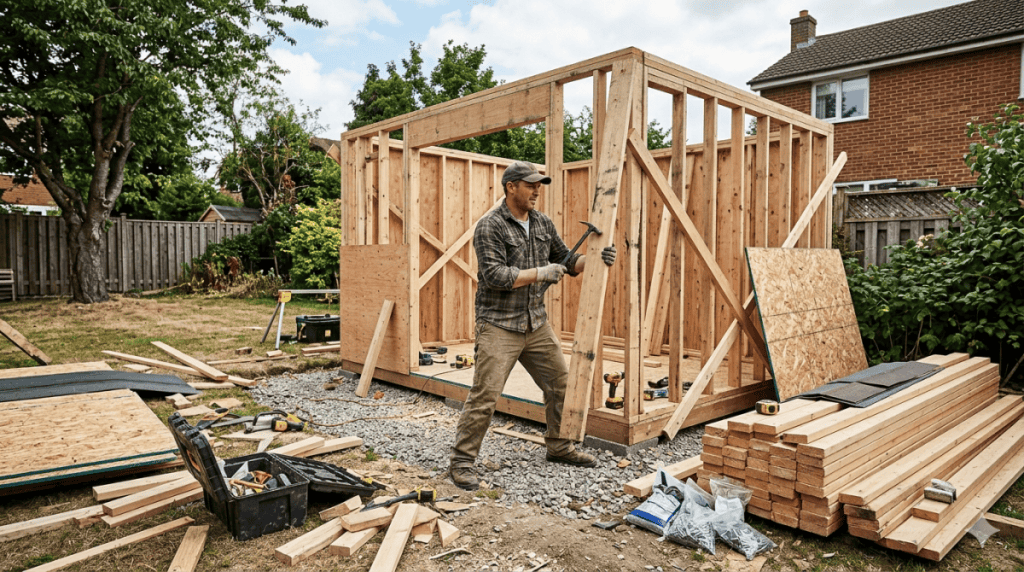
The Real Cost of DIY Sheds: Why That “$500” Backyard Build Might Cost You a Fortune
We have all been there. You walk into the local big-box hardware store, and there they are: the sleek, glossy shed kits staring at you from the promotional flyer. “Build it yourself in a weekend!” the tagline screams. “Save thousands!”
It is an intoxicating promise. You imagine yourself, hammer in hand, channeling your inner Bob Vila while the sun sets over your brand-new backyard storage palace. You look at the price of a pre-built shed from a professional dealer—often $4,000 to $10,000—and then you look at the DIY kit priced at $1,500. The math seems obvious. You think you are being financially prudent. You think you are being handy.

But here is the hard truth that the hardware store doesn’t want you to know: That $1,500 kit is rarely the finish line. It is just the cover charge.
Welcome to the iceberg of DIY shed economics. The visible tip is the lumber and nails. Hidden beneath the surface—wrecking your budget and your weekends—lies the real cost of DIY sheds. If you aren’t careful, you won’t just build a shed; you will build a money pit.
Let’s break down the hidden expenses, the emotional toll, and the mathematical reality of building your own storage shed. By the time you finish reading, you might just decide that paying the professional is the cheapest option of all.
The Illusion of the “Kit” Price
Let’s start with the bait. A standard 8×10-foot DIY shed kit often retails for between $1,500 and $3,000. This usually includes the pre-cut lumber, siding, roofing felt, nails, and hardware.
However, if you read the fine print—and nobody reads the fine print—you will notice a terrifying phrase: “Foundation not included. Shingles not included. Paint not included. Floor not included.”
Suddenly, your “complete” kit is just a box of sticks. You cannot put a wooden shed on dirt. It will rot within two years. You need a foundation. You need a weatherproof roof. You need to seal the wood. This is where Cost Number One comes to bite you.
Foundation Failures: The Silent Budget Killer
You cannot build a shed on grass. Moisture wicks up from the ground, turning your floor joists into a fungal buffet. You have three options for a foundation: a concrete slab, a gravel pad, or concrete piers.

-
The Concrete Slab: For an 8×10 shed (80 square feet), hiring a crew to pour a 4-inch slab will run you between $1,500 and $3,000. Doing it yourself saves labor costs, but concrete is heavy, technical work. If you mix bags by hand, you are looking at 80 to 100 bags of 80lb concrete. That is a $400 to $500 materials cost, plus a rented mixer ($60/day), plus a wheelbarrow, plus a month of chiropractic visits.
-
The Gravel Pad: Cheaper, but not free. You need to excavate topsoil (rent a sod cutter or tiller: $100/day), build a wooden retaining frame (pressure-treated lumber: $200), and fill it with 4 to 6 inches of compacted gravel (3 tons of gravel: roughly $150 to $300, plus delivery fees or truck rental).
-
Concrete Piers (Sonotubes): You need to dig holes below the frost line. That requires a post-hole digger ($40) or a powered auger rental ($75/day). You then need concrete, tubes, and brackets ($300+).
The Real Cost: Even on the cheap end with gravel, you are adding $500 to $1,500 to the project before you cut a single piece of the kit’s wood.
The Tool Trap: Buy It Once (Or Rent It Forever)
Here is a dirty secret of the home improvement industry: Shed manufacturers assume you own a fully stocked woodshop. Do you own a circular saw? Sure, maybe. But do you own a table saw for ripping the trim pieces that don’t fit? Do you own a compound miter saw for cutting the rafter tails at the correct angle?
If you are building from scratch (not a kit), the tool list is staggering:
-
Circular saw ($100)
-
Miter saw ($150-$300)
-
Drill and impact driver set ($150)
-
Level, framing square, chalk line ($50)
-
Hammer, pry bar, utility knife ($50)
-
Roofing nailer or hammer tacker ($60)
-
Safety gear (glasses, gloves, hearing protection) ($40)
-
Ladder to reach the roof ($150)
The Math: If you buy mid-tier tools, you are spending $500 to $800 just for the privilege of working. Sure, you can rent tools, but rushing a roof because the saw has to go back by 5 PM leads to mistakes. And mistakes cost money.

The “Overage” Factor: Waste and Mistakes
Professional builders can frame a wall with 2% waste. A first-time DIYer? You are looking at 15% to 20% waste.
You will mis-cut a rafter. You will nail through your finger and drop a board into the mud. You will realize you bought the wrong pressure-treated rating for ground contact. You will forget to account for the thickness of the siding when measuring your door opening.
Every trip back to the hardware store costs you not just the price of the new lumber (which has spiked in recent years), but the cost of your time and the gas in your truck.
The Verdict: Add 15% to your total material budget for “learning fees.” On a $2,000 material list, that is an extra $300.
The Valuation of Your Weekend: The “Time is Money” Equation
This is the cost that DIY calculators never include: Your labor.
Let’s say you make $35 an hour at your day job. A professional shed crew of three guys can frame, roof, and side a basic shed in one 8-hour day. That is 24 man-hours.

A single DIY builder working alone? That same shed will take you 40 to 60 hours spread over four to six weekends.
-
The Math: 50 hours of your time. If you value your weekend time at just $20/hour (a massive discount), that is $1,000 of lost leisure time.
-
The Opportunity Cost: Those six weekends could have been spent landscaping, painting the house, building a deck, or simply relaxing with your family. Instead, you are sweating in the July sun, covered in sawdust, cursing a warped 2×4.
When you buy a pre-built shed, you aren’t just paying for lumber; you are paying for the builder to have spent 10,000 hours learning how to do it in 8 hours what takes you 50.
Permit Panic and HOA Hell
Did you check your local zoning laws? Of course you didn’t; you were looking at the sale price at the hardware store.
Many municipalities require a building permit for any structure over 100 square feet. Some require it for any structure. An 8×10 is 80 square feet. You might be safe. But if you go up to a 10×12 (120 sq ft), you need a permit.
-
Permit Cost: $150 to $500.
-
The Real Risk: If you build without a permit and a nosy neighbor (or a drone from the tax assessor) spots it, you could face fines of $500 to $2,000. Worse, they could make you tear it down.
-
Setback Requirements: The law might require the shed to be 5 feet from the property line. You built it 3 feet away. Now you have to move a 2,000-pound structure or demolish it.
If you live in an HOA, the rules are even stricter. They might require specific siding colors, roofing materials, or architectural approval. Failing to comply can result in liens on your house.

Cost to ignore zoning: Potentially $5,000+ in fines or demolition fees.
The Roofing Riddle
Putting shingles on a shed roof looks easy on YouTube. In reality, it is heavy, hot, and dangerous.
You have to install drip edge ($40), ice and water shield ($60), felt paper ($50), starter shingles, and three-tab shingles ($150). Then you need ridge caps. You need roofing nails. You need to know how to flash the valleys if your roof is complex.
If you mess up the roof, you ruin the shed. Water gets in. The plywood delaminates. The framing rots.
The Hidden Cost: If you hire a roofer just to do the shingles on a small shed, they will charge a “minimum service call” of $500 to $800. If you do it yourself and fall off a ladder, the medical bills will bankrupt your shed budget entirely.
Paint, Primer, and Preservation
Wood is a sponge. If you don’t seal it within 30 days of building, it will check (crack), warp, and turn gray.
A decent exterior paint or stain for an 8×10 shed costs $40 to $60 per gallon. You need two gallons (primer + topcoat). That is $100. You need brushes, rollers, trays, and drop cloths ($50). You need a sprayer if you want to do it efficiently (rental $60/day or buy $200).
The Kick: You have to do this every 3 to 5 years for the life of the shed. A vinyl or metal pre-built shed never needs painting.

The “It’s Crooked” Tax
This is the cost nobody talks about because it hurts the pride. You get to the end of the build. You hang the door. It doesn’t close. The jamb is out of square by half an inch because you didn’t brace the wall properly during framing.
Now you have two options:
-
Live with a crooked shed and a door that scrapes the concrete (Cost: $0, but your soul hurts every time you look at it).
-
Buy a power planer and try to shave down the door, or rebuild the wall (Cost: $100 + 4 hours).
Quality differential: A professionally built shed is square, level, and plumb. A DIY shed is usually “close enough.” That “close enough” will bother you for the next decade.
Comparing Apples to Apples: DIY vs. Prefab vs. Built by Pro
Let’s run the actual numbers for an 8×10 (80 sq ft) shed with a single-slope or gable roof, one window, double doors, and asphalt shingles.
| Cost Category | DIY (Scratch) | DIY (Kit) | Pro-Built (On-site) | Prefab (Delivered) |
|---|---|---|---|---|
| Base Structure | $1,800 (lumber, plywood, nails) | $2,500 (the kit) | N/A | N/A |
| Foundation | $800 (gravel + timber) | $800 (gravel + timber) | $1,200 (included) | $1,000 (included) |
| Roofing (Shingles) | $300 | $300 | Included | Included |
| Paint/Stain | $150 | $150 | Included | Included (Vinyl) |
| Tool Purchase/Rental | $400 | $400 | $0 | $0 |
| Permit & Fees | $200 | $200 | $200 (builder handles) | $200 |
| Waste/Mistakes (15%) | $270 | $375 | $0 | $0 |
| Your Labor (50 hrs @ $20) | $1,000 | $1,000 | $0 | $0 |
| Delivery Fee | $0 | $0 | $0 | $350 |
| TOTAL COST | $4,920 | $5,725 | $4,500 – $6,000 | $3,500 – $5,000 |
Wait, look at the chart. The professionally built shed ($4,500) is almost exactly the same price as the DIY scratch build ($4,920). The prefab vinyl shed delivered is actually cheaper than the DIY kit ($3,500 vs $5,725).
When you account for your labor, DIY is not cheaper. It is equal or more expensive.

The Emotional Toll: The “Divorce Shed”
Walk into any marriage counselor’s office, and they will tell you about the “DIY Shed Phenomenon.” Couples who love each other deeply go to war over a 2×4.
-
“You measured wrong!”
-
“You didn’t hold the level straight!”
-
“We said we would be done in May; it’s now August!”
Building a shed is stressful. It tests your patience, your communication, and your tolerance for frustration. Is saving $500 worth three months of marital tension? Is it worth the dust in your living room? Is it worth the pallet of lumber sitting in the driveway that the HOA is complaining about?
When DIY Actually Makes Sense
I am not a hater of hard work. I believe in the spirit of self-reliance. DIY sheds make sense in specific scenarios:
-
You already own the tools. If you are a hobbyist woodworker with a shop full of Festool gear, your marginal cost for tools is zero.
-
You value the hobby over the economy. If you want to spend six weekends building because you find it therapeutic, ignore the math. Do it for joy, not for savings.
-
You are building a very weird size. If your property is a triangle and you need a 7-foot-3-inch wide shed, custom DIY is your only option.
-
You have free lumber. (Reclaimed pallets, a neighbor tearing down a barn, etc.)
For the other 95% of homeowners who just want a dry place to store the lawnmower and the Christmas decorations? DIY is a trap.

The Verdict: What Should You Do?
Buy a prefab vinyl or metal shed. They are delivered on a truck. They require a gravel pad (which you can DIY easily). They assemble with screws (not framing). They don’t rot. They don’t need painting. They cost $3,500 all-in, and you are done by lunchtime.
Or, hire a local shed builder. Many small-time carpenters specialize in “build on your pad.” They will frame it, roof it, and side it in two days. Because they buy lumber in bulk, they get better pricing than you do at Home Depot. They will finish at 5 PM on Sunday, and you will hand them a check, shake their hand, and go inside to watch the game.
The Bottom Line
The real cost of DIY sheds isn’t just the lumber in your backyard. It is the tool rentals, the wasted materials, the chiropractor bills, the gas station hot dogs you eat on the way to the hardware store for the fifth time, the weekend afternoons you never get back, and the quiet resentment you feel toward a building that was supposed to be easy.
Before you buy that kit, do the math honestly. Count your hours. Count your skills. Count your patience.
Because in the world of shed building, the cheapest way to get a roof over your lawnmower is rarely the one where you hold the hammer.