
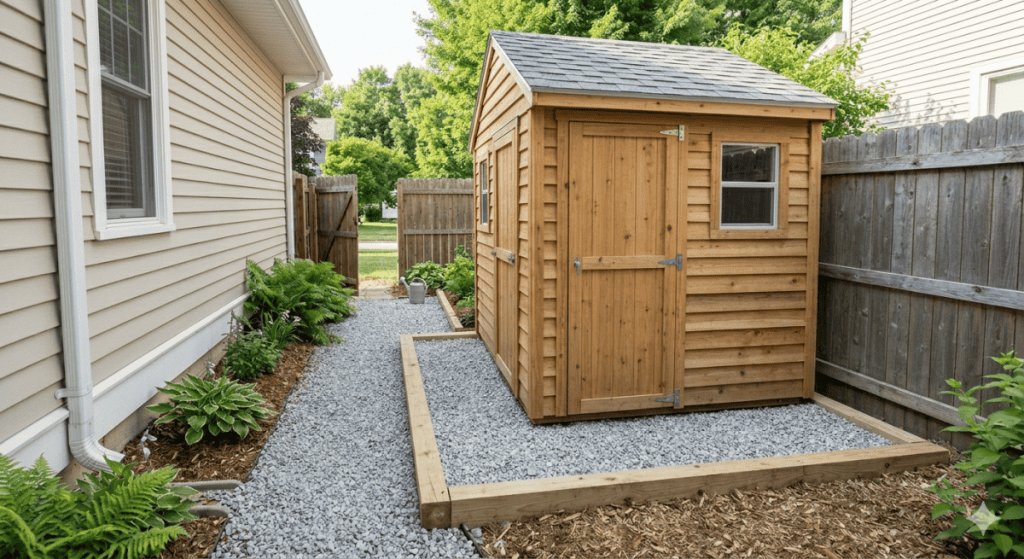
When homeowners peer into the narrow, forgotten corridor of their side yard, they typically see a problem: a damp, dark strip of weeds, a clumsy place to store trash cans, or a muddy pathway for the dog. What they rarely see is opportunity. But for the savvy DIYer or the budget-conscious property owner, that skinny slice of real estate is prime territory for one thing: a shed. The challenge, however, has always been the foundation. You cannot just drop a shed onto sloping, soft soil. You could pour a concrete slab, but that is expensive, permanent, and requires a fleet of trucks that cannot fit down a three-foot gangway. You could use deck blocks, but they shift and sink over time. This is where the secret weapon comes in.

The gravel pad is the unsung hero of side yard sheds. It is cheap, forgiving, permeable, and surprisingly strong. It is the foundation that landscape architects use but weekend warriors often overlook. This article will unlock the “gravel pad secret,” walking you through exactly why it works for side yards, how to build a bulletproof one in a tight space, and the drainage tricks that will keep your shed dry for decades.
Quick Navigation Menu
Why the Side Yard Demands a Better Foundation
The Hidden Enemy: Frost Heave and Hydrostatic Pressure
Selecting the Right Stone: The 3/4-Inch Rule
The Step-by-Step Guide to Build in a Narrow Space
The Shed Floor Interface: Skids vs. Runners
Shed Side Yard Drainage: The Unsung Superpower
Common Catastrophes and How to Avoid Them
Cost Comparison: Why Gravel Beats Concrete
Long-Term Shed Maintenance: The Five-Year Reset
The Environmental Argument for a Shed Gravel Pad
Conclusion: The Gravel Shed Foundation Secret Is Simplicity
Why the Side Yard Demands a Better Foundation
Before we dig into the gravel itself, you need to understand the unique physics of the side yard. Unlike a sunny backyard, a side yard is a marginal environment. It is usually shaded by the house and perhaps a fence. It catches roof runoff from gutters. In many climates, it stays damp longer than any other part of the property. Soil in these trenches is often compacted construction fill, clay, or a muddy mess.
A standard wood shed floor sitting directly on the ground would rot in five years. A shed on concrete pavers will settle unevenly as the clay expands and contracts with moisture. The secret to a long-lasting side yard shed is lifting the structure above the wet zone and distributing its weight over a large, stable, draining surface. A gravel pad does all three:
- Drainage: Water falls through the gravel and into the ground below, never pooling under your shed.
- Stability: Angular crushed stone locks together like puzzle pieces, resisting lateral movement.
- Breathability: Air circulates under the shed floor joists, preventing dry rot.
Furthermore, a gravel pad is one of the few foundations you can build by hand in a four-foot-wide alley. You do not need a wheelbarrow with a two-foot turning radius. You need a bucket, a tamper, and a clever plan.
The Hidden Enemy: Frost Heave and Hydrostatic Pressure
To truly appreciate the gravel pad secret, you must understand the enemy: frost heave. In cold climates, water in the soil freezes and expands upward with tremendous force—enough to crack a concrete slab or lift a corner of a prefab shed two inches out of level. A solid concrete pad acts like a sail, catching that upward force across its entire surface. A gravel pad, however, is a “drainable” foundation. Because water does not pool in the gravel, there is nothing to freeze and expand directly under the shed. The frost line penetrates, but the pad settles back down in spring without cracking.
Hydrostatic pressure is the second enemy. When heavy rains saturate the side yard soil, groundwater pushes upward. If you had a solid plastic or concrete floor, that pressure could actually float the shed or push moisture up through capillary action. Gravel breaks the capillary seal. Water rises to the gravel layer and then stops, because the air gaps in the stone create a vapor barrier of sorts.

This is why the professionals say: When in doubt, gravel it out.
Selecting the Right Stone: The 3/4-Inch Rule
The “secret” is often ruined at the hardware store by grabbing the wrong bag of pebbles. Pea gravel (smooth, rounded stones) is decorative and terrible for foundations. It rolls under weight like ball bearings. You need 3/4-inch crushed angular limestone or trap rock. The rough, jagged edges lock together under compaction, creating a solid mass that behaves almost like concrete.
Do not use recycled concrete or asphalt millings for a side yard shed. These materials often contain fine dust that holds moisture and turns to mud. You want “clean” crushed stone—meaning it has been washed and contains no “fines” (sand or silt). However, there is a nuance: for the final top layer, a “crusher run” or “dense grade” aggregate (stone with stone dust) can actually pack harder. But for drainage, clean stone is better. For a hybrid approach, use clean 3/4-inch for the bottom 4 inches and crusher run for the top 2 inches.
Quantity is another secret. A standard 8×10 shed weighs about 2,000 lbs empty. Fill it with garden tools, a mower, and winter tires, and you are looking at 3,500 lbs. That weight bears on four points or skids. Without a gravel pad, those skids sink into wet soil. A 6-inch deep gravel pad spreads that load over 80 square feet, reducing ground pressure to less than 5 pounds per square inch—well within what even soft clay can handle.
The Step-by-Step Guide to Build in a Narrow Space
Building a gravel pad in a side yard requires adapting standard instructions for confined spaces. You cannot simply rent a plate compactor that is 24 inches wide if your alley is 36 inches wide—you will never turn around. Here is the tactical sequence.
Step 1: Measure the Ghost Shed
You need a pad that is 12 inches wider and longer than your shed footprint. For a 6×8 shed in a tight side yard, build a 7×9 pad. Those extra 6 inches on each side give you room to work, prevent soil splash-up against the shed walls, and allow for drainage. Mark the corners with stakes, but realize that string lines are hard in narrow spaces. Use the house wall and the property line fence as your permanent reference edges.
Step 2: Excavate with a Mattock, Not a Shovel
In a narrow side yard, a standard shovel is too long. Use a mattock (a combination axe/adze tool) or a trenching shovel. Dig down 8 inches. Yes, 8 inches. You need 4 inches of compacted gravel plus a 4-inch sub-base of crushed stone. If the soil is pure clay, go down 10 inches. Remove all organic material—grass roots are your enemy because they rot and leave voids.
Pro secret: Do not haul the excavated dirt through the house. Slide a heavy-duty tarp under the work area, pile the dirt on the tarp, and then drag the tarp to the front yard. Your spouse will thank you.
Step 3: The Landscape Fabric Lie (and Truth)
Many articles tell you to lay landscape fabric under gravel to prevent weeds. For a side yard shed, do not do this. Standard landscape fabric is non-woven geotextile, but in a wet side yard, it can actually trap moisture and turn the subgrade into a soupy mess. Instead, use woven geotextile fabric (like Mirafi 140N), which allows water through while separating the gravel from the mud. Or, skip fabric entirely. Gravel alone, at 6-8 inches deep, will suppress weeds for years because seeds need light and soil to germinate.
If you do use fabric, run it up the house foundation and the fence posts by 2 inches to create a bathtub shape. This prevents soil migration from the sides.
Step 4: Compaction Is Everything
Pour the first 4-inch lift of gravel. Now, how do you compact it in a narrow space? A hand tamper (a heavy metal plate on a pole) is miserable work, but it is your only option. A 35-pound hand tamper, when lifted and dropped 150 times per 10 square feet, achieves 80% of the compaction of a machine. Wet the gravel slightly—damp gravel compacts better than dry stone. Work in 4-inch layers. After hand tamping for 30 minutes, you should be able to walk on the gravel without your shoes sinking.
Step 5: Leveling the Pad
You want the pad perfectly level from left to right, but pitched slightly (1/4 inch per foot) away from the house for drainage. Use a 4-foot level and a straight 2×4 board. Drag the 2×4 across the gravel; high spots will scrape, low spots will show. Add or remove stone accordingly. This is tedious but critical. A shed that sits unlevel will have doors that swing open or jam shut.
Step 6: The Retaining Edge
Because the pad is 6 inches above grade, you need a retaining edge to keep the gravel from spilling into the yard. In a side yard, use pressure-treated 2×6 lumber laid flat and staked into place with 12-inch spikes. Do not use plastic edging—it flexes. The 2×6 creates a defined perimeter that you can screw your shed’s skids directly into later, anchoring the whole structure.
The Shed Floor Interface: Skids vs. Runners
Here is a secret within the secret: Do not put the shed directly on the gravel. Sheds (especially resin or metal ones) need a frame. Build or buy a shed with pressure-treated 4×4 or 4×6 skid runners. These runners sit directly on the gravel. The weight of the shed transfers from the skids into the stone. However, gravel will slowly migrate under the skids over a decade. To prevent this, set the skids on three concrete patio stones buried flush with the gravel surface. The patio stones (12x12x2 inches) distribute the load even further and provide a hard, flat seat for the skids. Backfill around the stones with more gravel.
For a resin shed, which is lightweight, the gravel pad alone is enough, but you must anchor the shed to the ground with auger-style anchors driven through the floor and into the soil below the gravel. Otherwise, a windstorm will turn your resin shed into a tumbleweed in the side alley.
Shed Side Yard Drainage: The Unsung Superpower
The gravel pad’s primary job is drainage, but you must help it. In a side yard, you have two water sources: rain falling on the shed roof and water flowing down the house wall. Install gutters on the shed roof with a downspout that extends off the gravel pad. Do not let roof water dump onto the pad—that will eventually saturate the ground and overwhelm the gravel’s capacity. Divert that water to a rain barrel or a splash block that carries it to the lower yard.
Additionally, consider the “French drain edge.” On the uphill side of the side yard (the side closer to the house foundation, which usually has a gutter downspout), dig a 6-inch trench alongside the gravel pad, fill it with 1-inch clean stone, and wrap it in filter fabric. This intercepts subsurface water before it ever reaches your shed pad.
Common Catastrophes and How to Avoid Them
After building hundreds of gravel pads, I have seen three common failures in side yard applications:
- The “Skinny Shovel” Catastrophe: Homeowners try to excavate a 3-foot wide side yard with a standard shovel. They cannot swing the shovel, so they dig a wavy, uneven hole. The result is a gravel pad that is 2 inches deep in one corner and 8 inches deep in the other. Solution: Use a trenching spade or a garden trowel—yes, a trowel—for the fine grading. Accept that a narrow side yard is a hand-tool-only zone.
- The Plastic Shed Float: A 7×7 resin shed weighs only 150 lbs. On a gravel pad, it sits nicely until a 40 mph wind lifts it. Because the shed is so light, the gravel offers no resistance. Solution: Use 18-inch ground anchors driven through the shed floor at all four corners. Better yet, add a 50 lb bag of sand inside each corner.
- The Organic Layer Trap: A homeowner lays gravel directly over weeds and grass. The grass dies, rots, and creates a black organic sludge that stinks and holds water. The gravel pad sinks 3 inches into the muck within two years. Solution: You must scalp the soil down to mineral earth. No shortcuts.
Cost Comparison: Why Gravel Beats Concrete
Let’s talk dollars, because the “secret” is also financial. A 7×9 concrete slab, 4 inches thick, requires 0.78 cubic yards of concrete. That is roughly $150 in materials, but you cannot mix that by hand in a side yard—you would need 80 bags of 60-lb concrete. Add the rental of a mixer that won’t fit, plus rebar, forms, and a finisher. Realistically, a contractor will charge $1,200 to $1,800 for a side yard slab, mostly due to the difficulty of access. A gravel pad for the same area: $60 for 2 tons of 3/4-inch crushed stone (delivered), $30 for pressure-treated 2×6 edging, and $20 for a hand tamper rental. Total: $110. You save ten times the cost.
More importantly, a concrete slab in a side yard often violates local “permeable surface” ordinances. Many cities now limit non-porous surfaces to prevent stormwater runoff. A gravel pad is 100% permeable, meaning you likely won’t need a permit. Check local codes, but gravel is almost always the path of least resistance.
Long-Term Shed Maintenance: The Five-Year Reset
A gravel pad is not entirely maintenance-free, but the work is minimal. Every five years, rake the gravel surface to redistribute any stone that has migrated. Top up with a fresh 1-inch layer of clean crushed stone. This fills any compaction voids and keeps the surface sharp.
Watch for organic debris. Side yards collect leaves and windblown seeds. If those leaves rot on the gravel, they will start a compost layer. Once a year in spring, blast the gravel pad with a leaf blower or a garden hose on jet setting. Keep the stone bare.
Also inspect the edging. Pressure-treated wood lasts about 10 years in ground contact. When it begins to rot, replace it. If you want a permanent edging, use solid concrete block laid on their sides, but that requires a wider excavation.
The Environmental Argument for a Shed Gravel Pad
There is a quiet, modern secret to the gravel pad: it is the most eco-friendly shed foundation. No cement production (which accounts for 8% of global CO2 emissions), no chemical sealers, no plastic vapor barriers. Just stone mined locally and set into the ground. When you eventually remove the shed (perhaps to widen the driveway or add an addition), the gravel pad can be shoveled into a landscaping project or a drainage trench. It leaves no toxic legacy in the soil.
For the side yard, which often lies over groundwater recharge zones or utility lines, gravel is also the safest choice. Concrete slabs must be broken with a jackhammer if you ever need to access a sewer cleanout buried below. With gravel, you simply shovel it aside, dig, and then shovel the gravel back. It is reversible architecture at its finest.
Conclusion: The Gravel Shed Foundation Secret Is Simplicity
The “gravel pad secret” is not a product you buy or a trick you learn in a paid webinar. It is the simple, old-fashioned wisdom that sometimes the best foundation is the one that works with the earth, not against it. For the constrained, damp, narrow reality of a side yard, a concrete slab is an expensive, permanent, problem-prone solution. Plastic grids or deck blocks are temporary Band-Aids. But a well-built, 8-inch deep, 3/4-inch crushed stone pad is the quiet workhorse that will keep your side yard shed dry, level, and functional for 30 years.
The secret is this: Let water pass. Let air circulate. Let the stone lock. Your side yard shed—whether it holds bikes, potting soil, or a workshop bench—deserves a foundation that is stronger than it looks, cheaper than it has any right to be, and simple enough to build in a space barely wider than your shoulders. Stop looking at that forgotten alley as a problem. Start seeing the gravel pad for what it is: a secret waiting to be laid.