
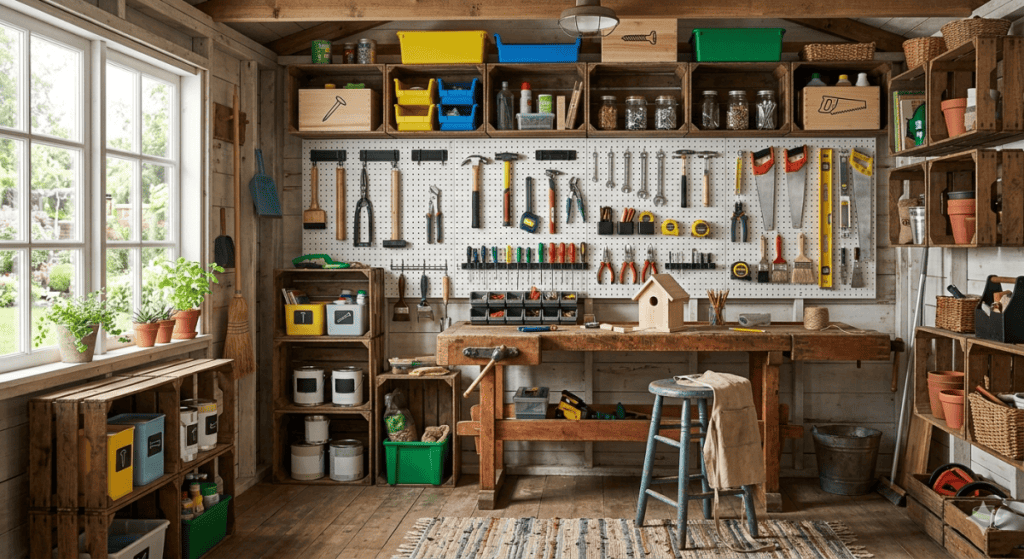
The humble shed. For decades, it has been the forgotten soldier of the suburban landscape—a dank, dark depository for rusty lawnmowers, half-empty paint cans, and spider families that have held the territory for generations. But a quiet revolution is underway. In an era of tiny homes, remote work, and rising housing costs, the backyard shed is being promoted from storage unit to sanctuary.
Whether you dream of a quiet writing retreat, a “she-shed” for crafting, a home gym, a podcast studio, or simply a tidy workshop, the biggest obstacle usually isn’t space—it’s money. Fitting out a shed can easily spiral into thousands of dollars. But here is the good news: with a heavy dose of creativity and a stubborn refusal to buy everything brand new, you can transform a 4×6 plywood box into a stunning micro-habitat without breaking the bank.
This guide will walk you through the psychology of small spaces, budget material sourcing, and 10 Specific, Cost-effective Shed Interior ideas to make your shed the coolest room in the house.

The Philosophy of Budget Shed Design
Before we pick up a hammer, we need to change our mindset. Decorating a shed on a budget isn’t about deprivation; it’s about resource allocation. In a tiny space, every object must earn its keep.
The three pillars of budget shed design are:
-
Verticality: If you can’t go out, go up. Floorspace is precious; walls are an untapped goldmine.
-
Illusion: You can’t change the square footage, but you can change how the eye perceives it. Mirrors, lighting, and color tricks are cheaper than an addition.
-
Repurposing: The landfill is full of treasures. Your shed’s interior should look like a curated curiosity shop, not a Big Box store showroom.
Let’s get to work.
Quick Navigation Menu
Phase 1: Preparation Without Spending a Fortune
Phase 2: Budget Foundations – Floors and Walls
Phase 3: Lighting – The Non-Negotiable
Phase 4: Furniture – Buy Nothing New
Phase 5: Creative Zoning on a Dime
Phase 6: The “Wow” Factor for Under $20
Phase 7: Climate Control – Cheap Comfort Ideas
Phase 8: Specific Shed Personas on a Budget
Phase 9: Sourcing the Trash-to-Treasure
Phase 10: The Final Polish – The “Invisible” Details
The Finale: Embracing Imperfection
Phase 1: Preparation Without Spending a Fortune
You cannot decorate a dirty, leaky, dangerous shed. However, preparation doesn’t require a contractor.
The Deep Clean and “Stuff Audit”
Take everything out. Everything. Pressure wash the interior (or use a stiff broom). This is free. Now, before you bring anything back in, audit your belongings. Do you really need three broken weed whackers? The budget-shed philosophy dictates that if it isn’t beautiful or useful, it goes to the dump or the “Free” section of Craigslist. A clean slate is the cheapest luxury you can buy.

Addressing the “Gross” Factors
Sheds are notorious for being damp and smelly.
-
Moisture: Look for light coming through the roof or walls. A tube of caulk ($4) and a few scraps of wood can patch 90% of leaks.
-
Smell: A bucket of plain cat litter (unscented) left in the corner for a week will absorb musty odors for pennies.
-
Insulation? Don’t panic. You don’t need fancy foam board. In mild climates, old denim scraps or even layered cardboard (which acts as a thermal break) stapled to the studs can take the edge off the cold. For a budget vapor barrier, heavy-duty contractor bags stapled to the walls work in a pinch.
Phase 2: Budget Foundations – Floors and Walls
Most sheds have ugly plywood floors and exposed studs. Hiding these usually costs money, but we are going to work with the rawness.
The $20 “Fake Laminate” Floor
Real hardwood or vinyl planks are expensive. Instead, buy a single sheet of 1/4-inch plywood underlayment ($15). Cut it into random-width strips (3 inches, 5 inches, 7 inches). Paint these strips three different shades of the same color (e.g., light gray, mid gray, dark gray). Once dry, stagger them on the floor like a herringbone pattern. Nail them down. Seal with a cheap water-based polyurethane. You just created a custom designer floor for less than the price of a pizza.
The Pallet Wall Feature
Pallets are the holy grail of the budget shed builder. Find a local warehouse or grocery store; they usually give them away for free.
-
Safety first: Sand them violently. You don’t want splinters.
-
The look: Break down the pallets. Stain the wood with “DIY stain” made from steel wool dissolved in vinegar (cost: $2). Mount the planks horizontally on one accent wall.
-
Why it works: The rustic texture hides imperfections in the existing shed walls. It adds warmth and costs nothing but labor.
Painting the Darkness Away
Never paint a shed ceiling dark. Never. Use “Ceiling White” flat paint (look for “Oops” paint at hardware stores—mis-tinted colors sold for $5/gallon). Paint the ceiling and the rafters white. This reflects light and tricks the brain into thinking the roof is higher. For the walls, choose a color that recedes: pale blue, sage green, or off-white. Avoid red or bright yellow, which will make the walls feel like they are closing in on you.
Phase 3: Lighting – The Non-Negotiable
A dim shed is a depressing shed. But rewiring for electricity costs thousands. Here are three workarounds.

Solar Shed Lights
Solar technology has improved dramatically. You can buy a string of waterproof solar LED fairy lights or a motion-sensor solar barn light for under $20. Mount the solar panel on the roof outside. Run the wire through a drilled hole (seal it with caulk). Instant ambient light for zero electric bill.
The Power Bank & LED System
For a working shed, you need task lighting. Buy a cheap LED floodlight (the type that plugs into a car cigarette lighter) and a rechargeable 20,000mAh power bank ($25). Use a command strip to mount the light. You get 12 hours of bright light per charge. Charge the bank in your house overnight.
The Mirror Trick
This isn’t a light source, but it multiplies light. Hit a thrift store for the largest, ugliest gold-framed mirror you can find ($5). Spray paint the frame matte black or white. Hang it opposite a window. It will immediately double the natural light in the shed.
Phase 4: Furniture – Buy Nothing New
Furnishing a small shed from IKEA defeats the budget purpose. We need modular, small-scale, and free.
The Spool Table
Electrical wire spools are often thrown away by construction crews. Find a medium-sized one. Flip it on its side. You now have a round table. Sand the top. Paint the edges. Use it as a desk or a craft table. If it is too tall, cut the center cylinder down.
The Ladder Shelf
Find an old wooden extension ladder at a garage sale ($5). Cut it in half lengthwise so you have two long tracks. Mount them horizontally to the wall studs using L-brackets. Place a plank of wood across the rungs. You now have a floating shelf system that holds books, plants, and radios.
Cinder Block and Wood Storage
Cinder blocks (80 cents each at a hardware store) are ugly, but they are structural. Stack two blocks, place a sanded 2×4 across them. Stack another two blocks. You have instant modular shelving for heavy tools or bins. Spray paint the cinder blocks a bright color (like cobalt blue) to make them look like pop art instead of masonry.

The “No-Cut” Bench
For seating, use two milk crates (ask a grocery store for broken ones) side by side. Lay a piece of thick plywood across them. Place a cheap foam gardening pad on top, covered with an old sweater or towel. You have a storage bench. The milk crates hold your books or yarn.
Phase 5: Creative Zoning on a Dime
In a 100-square-foot shed, you can’t have a separate room. But you can have a “visual room.” Use curtains.
The Tension Rod Divider
Buy a cheap tension shower rod (10)anda5 sheer curtain. Install the rod across the middle of the shed. When you want to hide your messy tool corner, pull the curtain closed. When you want to feel the whole space, open it. Sheer fabric keeps the light flowing while providing psychological separation.
The Pegboard Backsplash
Instead of buying kitchen backsplash tiles for a potting shed, buy a 4×8 sheet of hardboard pegboard ($15). Paint it a glossy color. Screw it to the wall above your workbench. Now your wall is your storage. Hang jars, scissors, rulers, and cups on pegboard hooks. It is art and organization merged.
Phase 6: The “Wow” Factor for Under $20
These are the details that make your friends say, “Wait, this is a shed?!”
The Bottle Cap Floor
Start saving bottle caps now. This is tedious but free. Once you have a bucket full, mix a bag of cheap mortar mix ($7). Pour the mortar into a low spot or a small defined area (like a doorway mat). Press the bottle caps flat-side down into the mortar, pushing them close together. Once dry, you have a custom mosaic floor insert that looks like a million bucks.

The Old Window Frame
Find an old wooden window frame (the kind with 6 panes) at an architectural salvage yard ($5-10). You don’t need glass. Clean it up. Hang it on the wall. In each pane, glue a different thing: a dried flower, a vintage postcard, a child’s drawing, a feather. It becomes a segmented art piece. Backlight it with a string of solar fairy lights for a glowing effect.
The Hose Pot
For a garden shed, hide the ugly coiled water hose. Find a large terracotta pot ($5 at a garage sale). Drill a hole in the bottom. Feed the hose end through the hole, attach the spigot, then coil the rest of the hose inside the pot. Place the pot next to the shed wall. It looks like a planter, not a utility item.
Rug Scraps as Art
Most people throw away the center of an old braided rug when it wears out. Grab the outer edge if it is intact. Nail the strip of rug edge along the top of the wall, close to the ceiling, like a wallpaper border. It adds massive texture and warmth for zero dollars.
Phase 7: Climate Control – Cheap Comfort Ideas
A shed is an oven in summer and a freezer in winter.
Summer Cooling (Under $10)
Buy a roll of “bubble wrap” (the big bubble kind). Spray a window with water. Press the bubble wrap onto the wet glass, bubble-side down. It acts as insulation and a sun blocker, but still lets light in. It reduces the temperature by up to 5 degrees.
Winter Heating – The Terracotta Heater
Do not use space heaters in a shed unless wired professionally (fire risk!). Instead, use a candle heater. Place two terracotta flower pots (one small, one large) on a non-flammable brick. Put a tealight candle under the small pot. Cover with the large pot. The pots heat up and radiate the warmth for hours. This will take the chill off a 50-degree shed.
Warning: Never leave open flame unattended.

Phase 8: Specific Shed Personas on a Budget
Depending on your hobby, the layout changes. Here is how to pivot the above ideas for specific uses.
The Artist Studio Shed
-
Idea: Hang a “drying rack” from the ceiling using a cheap wooden clothes drying rack.
-
Storage: Use baby food jars (free) screwed into the underside of a shelf to hold paintbrushes. Just screw the lid into the wood, fill the jar, and twist it back on.
The Reading Nook Shed
-
Idea: Create a “book spool.” Take a wire spool, lay it flat. Cut a hole in the center. Fill the hole with a beanbag chair or pillows. The spool becomes a walled fortress.
-
Lighting: A single $5 desk lamp pointed at the ceiling creates soft, diffused “mood” lighting better than overheads.
The Home Office Shed
-
Idea: The “Murphy Desk.” Hinge a large piece of plywood to the wall. When folded down, it’s a desk. Fold it up against the wall, and it becomes a bulletin board. Prop it up with a simple saw-horse (free scrap wood).
-
Cord management: Use binder clips glued to the back edge of the desk to hold charging cords.
The Yoga/Meditation Shed
-
Idea: Remove all furniture. Cover the floor entirely with foam floor mats for a gym ($20 for 4 tiles). Paint a single mandala on the wall using a bowl as a stencil (free).
-
Vibe: Hang mosquito netting from the ceiling around the perimeter. It softens the industrial edges of the shed for pennies.
Phase 9: Sourcing the Trash-to-Treasure
You cannot execute these ideas if you buy retail. Here is your budget sourcing hierarchy:
-
The Side of the Road (King of Budget): Drive around on bulk trash day. Look for wooden headboards (become shelves), old suitcases (become wall storage), and wicker baskets (become ceiling lights when you cut a hole in the bottom).
-
Facebook Marketplace “Free” Section: Refresh this constantly. People give away paint, pallets, bricks, and lumber daily to avoid dump fees.
-
Habitat for Humanity ReStore: This is a thrift store for building materials. Doors.
-
Dollar Store (For specific items only): Shower curtains (for dividers), command hooks (for hanging everything), and plastic bins (for waterproof storage). Avoid their tools; they break.
Phase 10: The Final Polish – The “Invisible” Details
The difference between a “shed” and a “studio” is often smell and sound.
Scent on a Budget
Do not buy plug-ins (they need electricity). Buy a bag of wood pellets (used for grilling, $5). Put them in a bowl with 10 drops of vanilla extract and cinnamon. The wood absorbs moisture and smells like a Christmas cabin for six months.

Sound Dampening
Sheds echo like crazy. To dampen sound for free, collect egg cartons. Spray paint them one color (e.g., metallic silver). Staple them to the walls in a pattern. They look like acoustic paneling (they aren’t great for sound, but they break up the echo just enough) and provide weird, cool texture.
The Threshold
The entrance to the shed should transition from “grass” to “inside.” If you have a gap under the door, roll up an old towel, sew the ends, and use it as a draft stopper (cost: needle and thread). Paint the towel to match the door.
The Finale: Embracing Imperfection
Here is the secret to the budget shed: Don’t try to make it look like a real house.
The charm of a shed interior is its rawness. When you use pallet wood and bottle caps and salvaged windows, you are telling a story. A perfect, drywalled, carpeted shed looks sterile and weirdly sad. But a shed with a patched-together floor, a repurposed ladder holding books, and a single solar light glowing through a mason jar looks intentional. It looks like a sanctuary.
You don’t need $5,000. You need a Saturday, a screwdriver, and the audacity to look at a pile of garbage and see a chandelier. Go outside, open that dusty door, and start measuring. Your shed is not just a building; it’s a blank canvas waiting for your cheap, brilliant, creative genius.
The Budget Breakdown Summary:
-
Cleaning & Caulking: $10
-
Pallet wall & white paint (“Oops” bin): $15
-
Solar string lights: $15
-
Power bank & LED: $25
-
Ladder shelf & cinder blocks: $12
-
Pegboard & hooks: $18
-
Mirror & spray paint: $8
-
Terracotta candle heater: $7
-
Miscellaneous (Command strips, zip ties, sandpaper): $10
Total Cost for a Magazine-Worthy Shed Interior: ~$120
Get to work. Your shed is waiting.