
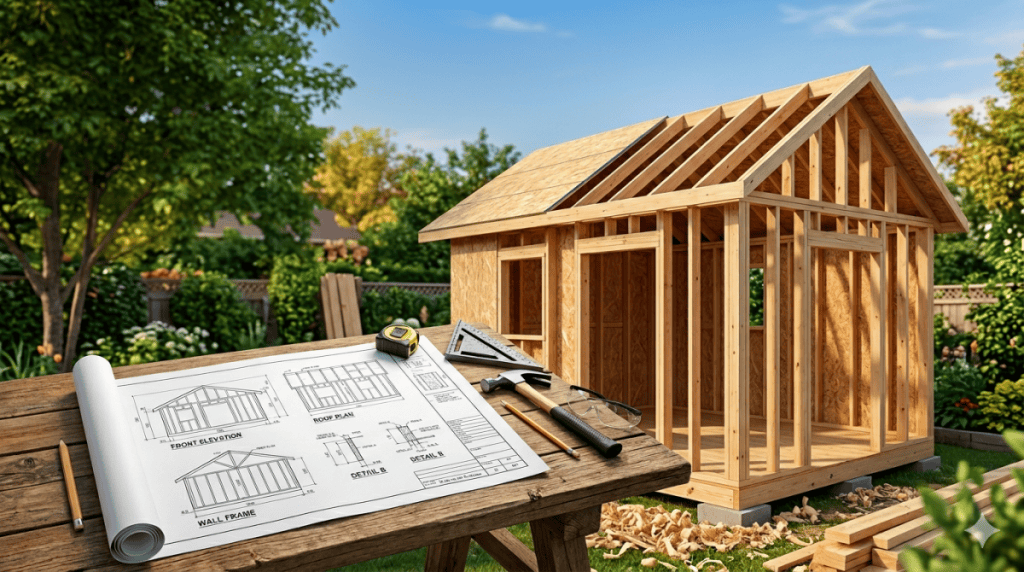
Why You Need Solid Construction Plans for a Shed
Looking for detailed construction plans for a shed? This 3000+ word guide covers blueprint types, framing, foundation choices, roof designs, and how to read plans like a pro.
It starts with a vision: a quiet corner for the lawnmower, a rustic workshop for weekend projects, or a garden potting bench bathed in morning light. You head to the local hardware store, buy lumber, nails, and a new circular saw, and then… you stop.
Where do you cut the first board? How deep do the footings go? Does the door need a header?
Without professional construction plans for a shed, you are not building; you are guessing. And guessing leads to leaning walls, sagging roofs, and a concrete slab that is six inches too short.
In this 3000-word guide, I’m going to tear down the mystery of shed construction. Whether you want a simple 8×10 garden storage unit or a 12×16 hobby retreat, you need a roadmap. We will cover the anatomy of a plan, where to find them, how to read them, and how to avoid the seven deadly sins of DIY shed building.
Struggling with Using FREE shed plans or BUYING shed plans? Check out my article How Do I Choose the Best Shed Plans? (Paid and Free)
Let’s lay the foundation—literally.
Quick Navigation Menu
Part 1: What Exactly Are “Construction Plans for a Shed”?
Part 2: The 5 Most Common Types of Shed Construction Plans
Part 3: Foundation First – Reading the Bottom of Your Plan
Part 4: Framing – Where the Plan Becomes Reality
Part 5: The Roof – The Most Misunderstood Part of the Plan
Part 6: Where to Find Quality Construction Plans for a Shed
Part 7: How to Read a Construction Plan for a Shed Like a Pro
Part 8: The 7 Deadly Sins of Shed Building (And How Your Plan Saves You)
Part 9: A Real-World Walkthrough – Building a 10×12 Gable Shed from Plans
Part 10: Advanced Modifications – How to Adapt a Plan to Your Site
Part 11: Digital vs. Paper – The Best Way to Use Your Plans
Frequently Asked Questions (From Real DIYers)
Part 1: What Exactly Are “Construction Plans for a Shed”?
Before you search Google for “free shed plans,” you must understand what a legitimate construction plan includes. A true plan is not a sketch on a napkin or a three-minute YouTube timelapse.
Professional construction plans for a shed typically include four critical components:
1. Foundation Plan
This drawing shows the footprint of your shed. It details the size and spacing of footings, foundation walls, or skids. It answers: Should I use a gravel pad, concrete piers, or a full slab?
2. Floor Framing Plan
This page illustrates the floor joists (usually 2×6 or 2×8 lumber), the rim joists, and the subfloor material (like 3/4″ plywood). It tells you exactly how far apart to place your joists—typically 16 inches on center (O.C.).

3. Wall Elevations and Framing
Here is the skeleton of your shed. Front, rear, left, and right views. These drawings show stud spacing (again, 16″ O.C.), window and door rough openings, header sizes, and corner construction. This is where most DIYers mess up—they forget that a door needs a double 2×6 header to carry the roof load.
4. Roof Plan
The most complex page. It details the roof pitch (e.g., 6/12, meaning 6 inches of rise per 12 inches of run), rafter spacing, ridge board dimensions, and overhang details. It also specifies sheathing and roofing material.
Pro tip: A good plan also includes a material takeoff sheet. This is a list of every 2×4, sheet of plywood, nail, and hinge you need. Without this, you will make six trips to the lumber yard.
Part 2: The 5 Most Common Types of Shed Construction Plans
Not all sheds are created equal. Your land, budget, and local climate dictate which set of construction plans for a shed you should buy. Here are the five archetypes.
2.1. The Gable Roof Shed (The Classic)
-
Best for: General storage, lawn equipment, bicycles.
-
Pros: Easy to build, water sheds efficiently, excellent attic storage.
-
Cons: Less wind resistance than a hip roof.
-
Plan highlights: Look for plans with a ridge board and common rafters. Avoid “truss” plans unless you have a crane.
2.2. The Saltbox Shed (The Aesthetic)
-
Best for: Property lines, historic districts, side-yard storage.
-
Pros: Asymmetrical roof allows for taller walls on one side; great for leaning against an existing garage.
-
Cons: Complex rafter cuts; requires precise math.
-
Plan highlights: Your plans must include a “birdsmouth cut” diagram. This is the notch where the rafter sits on the top plate.

2.3. The Lean-To (Pent) Shed
-
Best for: Attaching to an existing house or garage, firewood storage.
-
Pros: Simplest roof (single slope), cheapest to build, fewest materials.
-
Cons: Limited headroom, poor snow load capacity in northern climates.
-
Plan highlights: Ensure the slope is at least 2/12 for metal roofs or 3/12 for shingles.
2.4. The Barn Style (Gambrel) Shed
-
Best for: Maximum loft storage, hobby farms, workshops.
-
Pros: Incredible headroom; you can store a riding mower easily.
-
Cons: Complex compound angle cuts on rafters.
-
Plan highlights: You need a “gambrel rafter template.” Many plans provide a full-size printable pattern.
2.5. The Modern/Tiny Home Shed
-
Best for: Home office, Airbnb, she shed.
-
Pros: Insulated, wired, windows, often on skids for mobility.
-
Cons: Requires building permits and possibly engineering stamps.
-
Plan highlights: Look for sections on insulation R-values, vapor barriers, and electrical chase ways.
Part 3: Foundation First – Reading the Bottom of Your Plan

The most ignored page of construction plans for a shed is the foundation detail. Why? Because it involves digging, concrete, and patience. But a shed is only as good as what sits beneath it.
Your plans will specify one of three foundation types.
Here is how to interpret them:
A. The Skid Foundation (Mobile/Seasonal)
-
Plan language: “Three 4×6 pressure-treated skids, 4 feet apart.”
-
What to do: Lay pressure-treated 4×6 beams directly on compacted gravel. The shed rests on these. It will shift over time (frost heave), but it’s fine for lightweight storage.
-
Critical note: Your plan must show how to anchor the skids to prevent wind uplift. Use 24″ ground screws or rebar stakes.
B. The Gravel Pad (The DIY Favorite)
-
Plan language: “6” depth of 3/4″ crushed stone, compacted every 2 inches. Treated 2×6 perimeter frame.”
-
What to do: Excavate 8 inches of topsoil. Install landscape fabric. Build a timber frame. Fill with stone. This drains perfectly.
-
Critical note: The plan should show a “splash block” detail—a sloped concrete or plastic pad at the door to prevent rain from washing out the gravel.
C. The Concrete Slab (The Permanent Workshop)
-
Plan language: “4” thick 3000 PSI concrete over 4″ gravel, with #3 rebar 18″ O.C. each way.”
-
What to do: Form boards, vapor barrier, wire mesh or rebar, poured concrete broom finish.
-
Critical note: Your plan must include “anchor bolt” locations—these are 1/2″ bolts set into wet concrete that align with the sill plate of your shed. If you miss these, you cannot secure the walls.
Part 4: Framing – Where the Plan Becomes Reality

Now we get to the skeleton. A good set of construction plans for a shed will use industry shorthand. Here is how to decode it.
4.1. Wall Studs
-
Plan says: “2×4 SPF #2, 16″ O.C.”
-
Translation: Use Spruce-Pine-Fir, Grade #2 lumber. Place a stud every 16 inches measured from the center of one stud to the center of the next.
-
Common mistake: DIYers measure 16 inches to the edge of the stud. This throws off your sheathing layout. Always measure from the center.
4.2. Headers and Cripples
-
Plan says: “Door opening: 36″ wide. Header: Double 2×6 with 1/2″ plywood spacer.”
-
Translation: Above your door, you need two 2×6 boards sandwiching a piece of plywood. This creates a beam that transfers roof weight around the door.
-
Below the window: “Cripple studs” are short studs that fill the gap between the window sill and the bottom plate. Your plan will show exactly how many.
4.3. Corner Details
-
Poor plan: No corner detail (you will end up with a weak, wobbly corner).
-
Good plan: “Three-stud corner with blocking” or “California corner.”
-
Why it matters: A three-stud corner gives you a nailing surface for interior wall covering (if you finish the inside) and prevents the wall from twisting.
Pro tip: Lay your walls out on a flat garage floor before standing them up. Your plan includes a “wall layout diagram.” Use chalk lines on the concrete to map every stud location. This takes 45 minutes and saves 4 hours of frustration.
Part 5: The Roof – The Most Misunderstood Part of the Plan

If you show a novice a roof plan, they see a jumble of lines. But once you learn the vocabulary, it becomes a beautiful puzzle.
5.1. Reading Rafter Drawings
Your construction plans for a shed will include a “rafter detail” box. It looks like a triangle with numbers. Here is what those numbers mean:
-
Run: Half the width of your shed (e.g., 6 feet for a 12-foot wide shed).
-
Rise: How high the roof goes (e.g., 3 feet for a 6/12 pitch).
-
Pitch: Rise over run (6/12 means for every 12 inches horizontal, you go up 6 inches).
-
Birdsmouth depth: This is critical. The plan will say “max cut depth = 1/3 of rafter height.” If you cut deeper than that, the rafter will snap.
5.2. Overhang and Lookouts
-
Plan says: “12” overhang with 2×4 lookouts every 24″.”
-
Translation: Your rafters extend 12 inches past the wall. To support that overhang, you add “lookout” blocks that run perpendicular to the rafters.
-
Why DIYers fail: They skip the lookouts. The result is a wavy, drooping roof edge after one year.
5.3. Roof Sheathing Pattern
-
Plan says: “7/16″ OSB, H-clips between unsupported edges.”
-
Translation: Use oriented strand board. The H-clips are small plastic or metal clips that go between the 4-foot edges of the plywood where there is no rafter underneath. This prevents “bounce” under snow load.
Warning: If your plan calls for a “standing seam metal roof,” it will require purlins (horizontal 2x4s) on top of the rafters. Do not skip the purlins—metal needs ventilation and a solid nailing surface.
Part 6: Where to Find Quality Construction Plans for a Shed

You have two choices: free (dangerous) or paid (safe). Let’s be honest about both.
Free Plans (Proceed with Caution)
-
Sources: Pinterest, Ana White, Shanty-2-Chic, some lumber yard websites.
-
Red flags: No foundation detail. No snow load calculations. Scaled drawings (1 square = 1 foot, but not to scale). Missing hardware lists.
-
Verdict: Fine for a 4×6 tool lean-to in California. Terrible for a 12×16 in Minnesota.
Paid Plans (20to150)
-
Sources: iCreatables, MyShedPlans, The Family Handyman, Behm Design.
-
What you get: PDF vector drawings that scale perfectly. Material lists linked to current lumber prices. 3D renderings. Often, a cut list (exactly how long to cut each board).
-
Verdict: Worth every penny. A 50plancansaveyou800 in wasted lumber.
Engineered Plans (300to800)
-
When you need them: If your shed is over 200 square feet, or if you live in a high-wind (Florida, Texas coast) or high-snow (Maine, Colorado) zone.
-
What they include: A professional engineer’s stamp. Wind load calculations (e.g., 120 mph). Snow load calculations (e.g., 70 psf). Hurricane tie specifications.
-
Verdict: Required for building permits in most municipalities.
DO NOT buy a plan from a random Etsy seller who has a single blurry JPEG. You need a PDF with layers and dimensions.
Part 7: How to Read a Construction Plan for a Shed Like a Pro

Most people look at a plan and feel overwhelmed. Use the “Three Pass” method.
Pass 1: The Big Picture
Ignore every number. Just look at the 3D render or elevation drawings. Ask: Is this the shape I want? Does the roof slope away from my house? Is the door wide enough for my lawn tractor?
Pass 2: The Dimensions
Take a highlighter. Mark every external dimension: overall width, overall length, wall height, ridge height. Then compare those to your yard. *Will an 8-foot tall shed fit under that maple tree?*
Pass 3: The Callouts (The Small Text)
This is where secrets hide. Look for words like:
-
“TYP” (Typical) – means this detail repeats everywhere. Do not reinvent the wheel.
-
“O.C.” (On Center) – critical for studs, joists, rafters.
-
“PT” (Pressure Treated) – required anywhere wood touches concrete or soil.
-
“GALV” (Galvanized) – nails, screws, and ties must be galvanized to resist rust.
Pass 4: The Schedule
Most plans end with a “door schedule,” “window schedule,” and “hardware schedule.” This is a boring table. Read it. It tells you exactly which hinges (e.g., 4″ x 4″ tee hinges) and which nails (e.g., 16d galvanized commons) to buy.
Part 8: The 7 Deadly Sins of Shed Building (And How Your Plan Saves You)
Even with great construction plans for a shed, DIYers find ways to mess up. Here are the sins your plan will prevent if you actually follow it.
Sin #1: The Wrong Lumber
-
Plan says: “2×4 studs, 8′ length.”
-
DIYer buys: 2x6s because “stronger is better.”
-
Problem: 2x6s weigh twice as much, cost 2x more, and throw off your window rough openings.
-
Solution: Trust the plan.
Sin #2: Skipping the Sill Seal
-
Plan says: “1/2″ foam sill sealer between foundation and sill plate.”
-
DIYer thinks: “It’s just foam.”
-
Result: Concrete wicks moisture into the wood. Rot within 3 years.
-
Solution: Buy the $12 roll of sill sealer.

Sin #3: Ignoring Rafter Ties
-
Plan says: “Ceiling joists (rafter ties) every 4 feet.”
-
DIYer thinks: “I want high ceilings, so I’ll omit them.”
-
Result: The roof pushes the walls outward. The shed looks like a trapezoid.
-
Solution: Install the rafter ties exactly as shown.
Sin #4: Under-Spaced Nails
-
Plan says: “8d nails, 6″ O.C. on panel edges.”
-
DIYer uses: 12″ spacing to save time.
-
Result: Sheathing peels off in a wind storm.
-
Solution: Follow the nailing schedule.
Sin #5: No Weather Barrier
-
Plan says: “House wrap (Tyvek or similar) over sheathing.”
-
DIYer skips it: “OSB is fine.”
-
Result: Condensation inside the shed rusts your tools.
-
Solution: Spend $40 on house wrap.
Sin #6: Wrong Roofing Nails
-
Plan says: “1-1/4″ galvanized roofing nails with neoprene washer.”
-
DIYer uses: Staples or regular box nails.
-
Result: Nails back out. Leaks.
-
Solution: Buy the right nails.
Sin #7: The Permit Assumption
-
Plan says: “Check local codes before building.”
-
DIYer ignores this.
-
Result: The city makes you tear down a finished shed. (Yes, this happens weekly.)
-
Solution: Spend 30 minutes at your local building department.
Part 9: A Real-World Walkthrough – Building a 10×12 Gable Shed from Plans

Let’s put theory into practice. Imagine you bought a set of construction plans for a shed that is 10 feet wide by 12 feet long, with a 6/12 gable roof.
Step 1: Layout (Page 2 of your plans)
You stake out a 10’6” x 12’6” area (extra 6 inches for the gravel overhang). You dig 6 inches of soil. You compact the ground.
Step 2: Foundation (Page 3)
Your plan shows a gravel pad. You install 4×6 pressure-treated skids directly on the compacted gravel. You check diagonals: corner to corner must be equal. If it is 15’ 7” one way and 15’ 9” the other, you are out of square. You adjust.
Step 3: Floor Deck (Page 4)
You lay 2×6 joists (16” O.C.) on top of the skids. You add a rim joist around the perimeter. You screw down 3/4″ plywood. You sweep the deck.
Step 4: Wall Framing (Pages 5-8)
On the deck, you lay out your front wall. 2×4 studs, 16” O.C. A 36” rough opening for the door. Double top plate. You nail it together, then tip it up. You brace it. Repeat for the back and side walls.
Step 5: Roof (Pages 9-11)
You cut one rafter using the pattern on Page 9. You test fit it. Perfect. You use that rafter as a template to cut 15 more. You install the ridge board. You nail up rafters.
Step 6: Sheathing and Finish (Pages 12-15)
You nail OSB to the walls. You wrap the shed in house wrap. You install windows. You nail OSB to the roof. You apply felt paper. You install shingles. You hang the doors.
Total time: Three weekends.
Total lumber waste: Less than one 2×4.
Part 10: Advanced Modifications – How to Adapt a Plan to Your Site
Sometimes a perfect plan exists, but your site is weird. You have a slope, a tree, or a property line setback. Here is how to legally modify your construction plans for a shed.
If you have a slope: Look for plans labeled “post-and-beam foundation.” These allow you to use adjustable post bases (like Simpson CBSQ) to level the shed on a slope up to 15 degrees.
If you need larger doors: You cannot just widen a door opening without recalculating the header. Instead, search for “equipment shed plans” that start with a 5-foot or 6-foot double door.
If you want to add a loft: The plan must show the floor joists for the loft. You cannot just screw plywood to the rafters. Loft joists need to rest on load-bearing walls.
Important: Any modification voids the engineer’s stamp. If you modify a stamped plan, you must get a new engineer’s review or accept liability yourself.
Part 11: Digital vs. Paper – The Best Way to Use Your Plans

You have purchased your plans. Now you have a PDF. How do you use it on the job site?
The paper method: Print the plan on 11×17 or 24×36 paper (Kinkos or Staples). Laminate the critical pages (foundation and framing). Use a pencil to mark your measurements directly on the paper. Paper survives rain, sawdust, and dropped hammers.
The digital method: Load the PDF onto a cheap tablet (Amazon Fire or iPad). Use a PDF reader (like GoodNotes or Xodo) to highlight and write notes. The advantage: You can zoom in on the birdsmouth detail 400%.
The hybrid method: Print the cut list and material list. Keep the rest digital. This saves 60 sheets of paper but keeps the most-used page in your pocket.
Never rely on your phone. The screen is too small to read rafter angles, and a dropped phone on concrete is a $200 mistake.
Frequently Asked Questions (From Real DIYers)
Q: Can I use construction plans for a shed to get a building permit?
A: It depends on your city. For sheds under 120 sq ft, many cities don’t require a permit. For larger sheds, they will require a stamped plan. If your plan has no engineer’s stamp, you will be rejected. Call your building department and ask: “Will an unstamped residential plan work for a 10×12 accessory structure?”
Q: How much does it cost to print a 24×36 shed plan?
A: Approximately 6to12 per page at a blueprint shop. Get a quote for “black and white engineering prints.”
Q: What is the hardest part of reading construction plans for a shed?
A: The roof section. Specifically, the “rafter length” and “birdsmouth depth.” Even experienced carpenters use a framing square or a rafter calculator app (like Rafter Tools) to double-check.
Q: Can I build a shed from a plan if I have zero construction experience?
A: Yes, but you need a plan rated “Beginner” or “DIY Friendly.” Look for plans that include a “step-by-step build video” or “3D interactive model” via a QR code. Avoid plans that say “Advanced” – those assume you know what a double-cripple header is.
Q: Do I need separate plans for a concrete slab?
A: Yes. Standard shed plans show the footprint. You need a separate “slab on grade” detail from an engineer or a concrete-focused plan if your soil is expansive (clay) or sandy.
The Blueprint to Success
Building a shed is one of the most satisfying DIY projects you can tackle. In one weekend, you can turn a pile of lumber into a functional, beautiful structure. But just as you would not bake a cake without a recipe, you should never frame a wall without proper construction plans for a shed.
A great plan protects your wallet (no wasted wood), protects your time (no re-dos), and protects your safety (no collapsing roofs). It translates your vague idea—”I want a shed over there”—into precise numbers: a 2×4 here, a rafter there, a hurricane tie everywhere.
So before you start your circular saw, start your search. Buy the right plan. Read it twice. Measure three times. And then build the shed you have always wanted.