
Introduction: The Architectural Crossroads
When building a new shed or undertaking a major addition, few decisions carry as much structural, aesthetic, and financial weight as the choice of the roof framing. The roof is not merely a cap to keep the rain out; it is the architectural crown of the structure, defining its silhouette, protecting its inhabitants, and bearing the brunt of nature’s fury. As you delve into the blueprints, you will inevitably arrive at a fundamental crossroads: rafters vs. trusses. This choice is more than a simple preference; it is a decision that impacts your budget, your timeline, your interior design, and even the future resale value of your home.
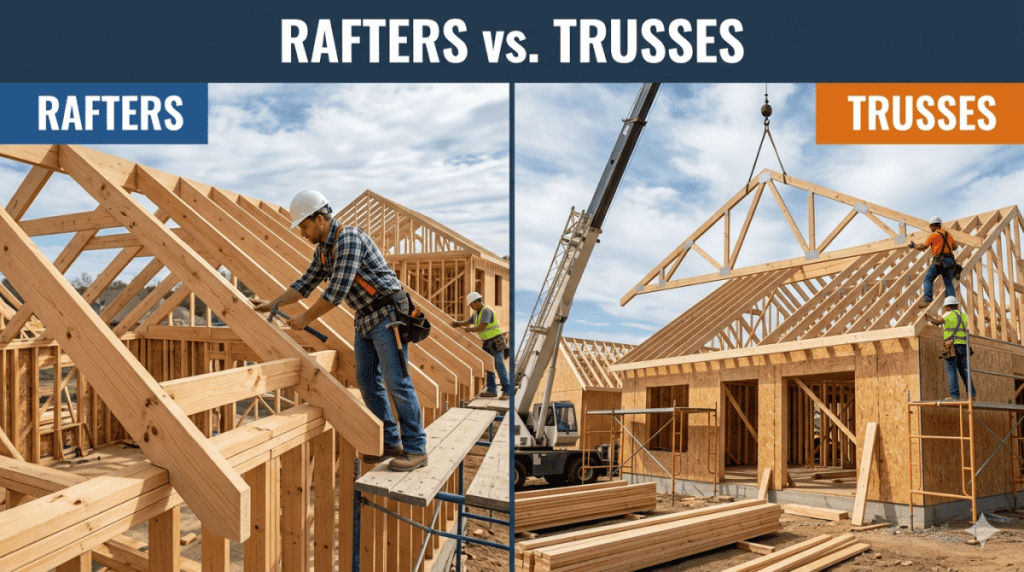
For the uninitiated, the terminology can be daunting. Rafters are the traditional, time-honored method of framing a roof—think of them as the handcrafted, on-site construction of a wooden skeleton. Trusses, on the other hand, are the modern marvel of engineering; they are prefabricated, triangulated units built off-site and hoisted into place with a crane. Both achieve the same primary goal of supporting the roof deck, but they do so in vastly different ways with distinct advantages and disadvantages.
This article aims to dissect the age-old debate of rafters vs. trusses with surgical precision. I will explore the history, construction methods, structural nuances, cost implications, design flexibility, and environmental factors of each system. By the end of this 2,500-word deep dive, you will have the comprehensive knowledge required to make an informed decision that aligns with your specific project goals.
Whether you are an architect seeking design freedom or a homeowner on a strict budget, understanding the core differences between these two framing giants is paramount to the success of your build. I’ve broken this article into 5 chapters. Let’s dig in!
Quick Navigation Menu
Chapter 1: Understanding Rafters and Roof Trusses
Chapter 2: Advantages and Disadvantages of Trusses and Rafters
Chapter 3: Head-to-Head Comparison – Rafters vs Trusses
Chapter 4: Rafters or Trusses for Vaulted Ceilings, Storage, and Climate
Chapter 5: Making the Decision for Trusses or Rafters– A Practical Guide for the Homeowner
Conclusion: There is No “Wrong” Answer, Only the Right Fit
Questions and Answers “Trusses vs Rafters”
Chapter 1: Understanding Rafters and Roof Trusses
Before we pit them against each other, we must first understand what exactly we are dealing with. Let’s break down the anatomy of each system.
What Are Rafters?
Rafters are the traditional framework of a roof. They consist of a series of sloped wooden beams that extend from the ridge (the peak of the roof) down to the eaves (the lower edge). In a standard “stick-framed” roof, these rafters are installed in pairs, meeting at the top to form the “A” shape of the roof.
Key Components of a Rafter System:
-
Common Rafters: The primary structural members that run perpendicular from the ridge to the top plate of the wall.
-
Ridge Board: The horizontal timber at the apex where the upper ends of the rafters meet. (Note: In modern engineering, this is often a ridge beam to handle heavy loads).
-
Birdsmouth Cut: A notch cut into the rafter where it sits on the wall plate, providing a flat, secure bearing surface.
-
Collar Ties: Horizontal members placed higher up on the rafters to prevent the roof from spreading apart under load.
-
Rafter Ties/Ceiling Joists: Members that connect the bottoms of the rafters to prevent the walls from pushing outward.
The installation of rafters is a highly skilled craft, relying on the carpenter’s ability to cut each piece to fit the specific angles and dimensions of the building. This method has been used for centuries and allows for immense customization.
What Are Trusses?
Trusses are a more modern invention, gaining widespread popularity in the mid-20th century. They are prefabricated structural frameworks, usually made of 2×4 or 2×6 lumber, connected by metal connector plates (also known as gang-nails). The design is based on the principle of triangulation, which is the most stable geometric shape in engineering.
Key Components of a Truss:
-
Top Chords: The members that form the sloping top edge of the roof, upon which the roof sheathing is attached.
-
Bottom Chord: The horizontal member that forms the base of the truss. In many designs, this doubles as the ceiling joist for the room below.
-
Webbing: The network of internal diagonal and vertical members (webs) that connect the top and bottom chords, creating the triangular structure that distributes the load efficiently.
-
Metal Connector Plates: The galvanized steel plates pressed into the wood at each joint to connect the members.
Trusses are engineered by specialists using complex software to handle specific loads (snow, wind, seismic) and spans. They are manufactured in a factory setting, ensuring precision and consistency, and then delivered to the job site ready for installation.
Chapter 2: Advantages and Disadvantages of Trusses and Rafters
Now that we understand what they are, let’s examine the pros and cons of each system in the context of a typical residential construction project. This is where the debate of rafters vs. trusses truly heats up.
The Case for Trusses: The Modern Marvel
Trusses have become the industry standard for many residential developments, and for good reason.
-
Cost Efficiency: This is arguably the biggest advantage. Trusses are manufactured in bulk, allowing lumber suppliers to optimize material usage, reducing waste. The speed of installation means less labor time on-site, which translates to significant cost savings on the crew’s wages. For a standard rectangular home, trusses are almost always the cheaper option.
-
Speed of Installation: Imagine having a 20-man framing crew spend two weeks cutting and installing rafters. Now imagine a crane and a 4-man crew installing an entire roof system in a single day. That is the power of trusses. The prefabricated nature allows for rapid enclosure of the building envelope, protecting the interior from weather and allowing subsequent trades (electricians, plumbers, HVAC) to start their work sooner.
-
Longer Spans Without Support: Trusses can easily span 30, 40, or even 50 feet without requiring load-bearing interior walls. This allows for the creation of vast, open floor plans and cathedral-like spaces in living rooms and great rooms.
-
Design Flexibility (Structurally): While limited in attic space, trusses offer great flexibility in terms of the shape of the roof. They are not limited to simple gable ends; they can be designed as hip trusses, scissor trusses (to create vaulted ceilings), piggyback trusses (to achieve high pitches), and complex gambrel or mansard profiles.
The Case Against Trusses: The Drawbacks
Despite their dominance in tract housing, trusses have limitations that can be deal-breakers for custom homeowners.
-
Limited Attic Space: Because of the “web” of diagonal bracing in the middle of the truss, the usable space in the attic is virtually zero. Unless you specify a “storage truss” (which has a larger open area in the center), you cannot use the space for anything other than running a few utilities. You cannot build a room, store holiday decorations, or install a heavy water heater in a standard truss attic.
-
Inflexibility for Modifications: Once a truss is engineered and installed, it is a monolithic structural unit. You cannot cut into the webbing to run a duct or a pipe without potentially compromising the structural integrity of the roof. If you need to modify the roof (e.g., add a skylight or a dormer), the truss must be specifically engineered and built for that feature from the start. Post-construction modifications are expensive and require complex engineering analysis.
-
Transportation and Access Limitations: Trusses are large and require a crane or a boom truck for installation. If your building site is in a remote area, a dense forest, or has limited street access, the delivery and installation of trusses can be logistically challenging and expensive.
The Case for Rafters: The Craftsman’s Choice
In the world of custom homes and architectural distinction, rafters remain the gold standard.
-
Maximum Attic Space: This is the primary reason homeowners choose rafters over trusses. A stick-framed roof creates a vast, open, and unobstructed attic space. This space can be finished into a luxurious master suite, a home office, a playroom, or provide substantial storage. Converting an attic from rafter framing into usable living space is significantly easier and more cost-effective.
-
Architectural Freedom and Customization: Rafters offer limitless design possibilities. Architects love them because they allow for intricate rooflines, overhangs, valleys, and dormers that are difficult or impossible to achieve with pre-engineered trusses. If you want a home with a unique, non-rectangular footprint, a complex roofline, or deep eaves for aesthetics, rafters are the superior choice.
-
Ease of Post-Construction Modifications: Want to add a skylight after the house is built? Need to run a new exhaust fan or a large HVAC duct? With rafters, you simply cut and frame the opening around the rafters. The open space allows for far greater flexibility for future renovations and installations.
-
Load Distribution: Rafter systems, when properly tied with collar ties and ceiling joists, create a “rigid frame” that can be very strong. Some builders argue that the redundancy of a well-built rafter system (lots of smaller cuts vs. fewer large engineered pieces) provides a fail-safe structure that handles uneven settling or snow loads more gracefully.
The Case Against Rafters: The Price of Perfection
The beauty and flexibility of rafters come at a cost—literally and temporally.
-
Higher Material and Labor Costs: Rafters typically use larger dimension lumber (2x10s or 2x12s) compared to the 2x4s used in trusses. This increases material costs. Furthermore, the skilled labor required to cut and fit each rafter by hand takes significantly more time. This translates to a framing budget that can be 20-50% higher than using trusses.
-
Longer Construction Timeline: The slow, methodical process of stick-framing means the roof takes weeks to install, not days. This delays the “drying-in” of the house and pushes back the schedule for other trades.
-
Requires Interior Load-Bearing Walls: For wider homes, a rafter system cannot span the width of the house alone. It typically requires an interior load-bearing wall or a structural ridge beam (which is expensive heavy timber or steel) to support the center of the span. This can limit the open-floor-plan design.
-
Thermal Bridging: The thick rafters (2×10 or 2×12) provide a direct path for heat to travel from the interior to the exterior, contributing to thermal bridging. While this is not a deal-breaker, it requires careful attention to insulation detailing (like adding rigid foam on the exterior) to maximize energy efficiency.
Chapter 3: Head-to-Head Comparison – Rafters vs Trusses
To truly understand the rafters vs. trusses debate, we must compare them across specific metrics relevant to the homeowner and builder.
1. Cost Analysis
-
Trusses: Generally cheaper by 15-30% on the total roof system. Savings come from optimized material use, factory labor efficiency, and reduced on-site labor.
-
Rafters: More expensive due to larger lumber sizes, higher waste, and intensive on-site carpentry. However, if the plan is to finish the attic, the cost difference can be offset by the fact that the second floor is already partially framed.
2. Design and Interior Space
-
Trusses: Ideal for single-story homes or two-story homes where the attic is purely functional. They allow for wide open spaces on the first floor.
-
Rafters: Essential for homes where the attic is intended for living space. They offer unparalleled aesthetic beauty for exposed-beam ceilings.
3. Engineering and Structural Integrity
-
Trusses: Engineered as a unit. They are incredibly strong for their weight and designed to hold specific load capacities. The triangulation distributes weight evenly to the exterior walls.
-
Rafters: Rely on the strength of the individual members and the triangulation of the entire system (including ceiling joists). They can be over-engineered by builders using larger lumber “just to be safe,” but this adds cost.
4. Energy Efficiency
-
Trusses: The webbing allows for excellent ventilation (creating a cold roof) and allows for deep, uninterrupted insulation in the attic floor (above the ceiling). However, achieving a “conditioned attic” for HVAC equipment is more difficult due to the multiple penetrations of the web.
-
Rafters: Present a challenge for insulation. The cavity between rafters is usually not deep enough for high-R-value insulation in cold climates. Builders must resort to spray foam directly against the roof deck or install rigid insulation on top of the roof, which increases cost.
5. The “Subjective” Factor: Aesthetics
-
Trusses: Functional, utilitarian, and hidden behind drywall. They are not meant to be seen.
-
Rafters: Can be left exposed for a stunning architectural feature. The sight of heavy timber rafters and a structural ridge beam creates a sense of warmth and craftsmanship that cannot be replicated by steel plates and 2×4 webbing.
Chapter 4: Rafters or Trusses for Vaulted Ceilings, Storage, and Climate
The choice between rafters vs. trusses is often dictated by specific project requirements.
The Quest for Vaulted Ceilings
If you want a vaulted ceiling (a high, sloped ceiling), both systems can achieve this, but differently.
-
Scissor Trusses: These are pre-fabricated trusses designed with a sloped bottom chord. This creates a vaulted ceiling effect while keeping the webbing hidden above the drywall. This is the cheapest way to get a vaulted ceiling.
-
Rafters with a Ridge Beam: This is the “true” vaulted ceiling. The rafters run from the ridge beam down to the exterior walls. There are no ceiling joists, so the space is completely open. This requires a massive structural ridge beam (often laminated veneer lumber or steel) to support the load, making it a significantly more expensive option but offering a larger, more dramatic space.
Storage and Future Expansion
-
Trusses: If you want to guarantee future storage, you must order “attic” or “room-in-attic” trusses. These have a rectangular open space in the center of the web. While this adds to the cost, it is far cheaper than building a custom rafter roof. Standard trusses will crush your dreams of an attic workshop.
-
Rafters: This is the no-brainer option for storage or expansion. The open floor gives you a blank canvas.
Climate Impact
-
Snow and Wind Loads: In regions with heavy snow, trusses are often favored because of their precise engineering. However, in areas prone to high winds, the redundancy of a rafter system can be an advantage, as the structure has more individual points of connection. A properly engineered truss, however, is equally capable of handling high winds.
-
Thermal Performance: In extreme cold or heat, trusses generally perform better with standard construction because the insulation is laid flat on the ceiling, which is easier to install without gaps. Rafter roofs are more prone to “hot roofs” or “cold roofs” issues unless properly ventilated or designed with a “flash-and-batt” insulation strategy.
Chapter 5: Making the Decision for Trusses or Rafters– A Practical Guide for the Homeowner
You have read the facts. Now, how do you decide? Here is a step-by-step guide to navigating the rafters vs. trusses decision.
-
Define the Purpose of Your House: Is this a “forever” home where you want to customize every inch and potentially expand later? Or is it a “starter” home or investment property where cost and speed are the primary drivers?
-
Examine the Blueprint: Look at the floor plan. Are there load-bearing walls in the center? Is the footprint a simple rectangle or a complex “L” or “U” shape?
-
If you want an open floor plan with no interior support walls: Trusses are often the best (and cheapest) way to achieve a 40-foot clear span.
-
If you want a second-floor bonus room or a master suite: Rafters are almost certainly your path.
-
-
Get the Prices: Talk to your builder and get quotes for both systems. Ask for a “cost difference” specifically for the trusses vs. stick-framing. Then, factor in the cost of the attic floor if you plan to finish it.
-
Think Long-Term: A cheap truss roof saves money today. A rafter roof offers future living space. Which adds more value to the home? In many real estate markets, a finished attic adds significant square footage and value, which can offset the higher initial cost of the rafters.
-
Consult an Engineer or Architect: If you have specific aesthetic desires (exposed beams, complex geometries), a professional can tell you if a truss can be modified to look a certain way or if you must use rafters.
Conclusion: There is No “Wrong” Answer, Only the Right Fit
The battle of rafters vs. trusses is not a battle of good versus evil. It is a battle of purpose versus efficiency. There is no inherently “better” system; there is only a system that is “better” for your specific project.
If you are building a spec home in a suburban development where speed to market and ROI are paramount, trusses are the undisputed champion. They are cheaper, faster, and structurally sound. They allow you to build wide, open spaces that modern buyers crave.
However, if you are building a custom home on a wooded lot, where the charm of the house lies in its unique angles, deep overhangs, and the potential for a cozy loft or a vaulted great room, then stick-framed rafters are worth every extra penny. They allow the home to breathe, to adapt, and to exude a quality of craftsmanship that a truckload of gang-nailed plates simply cannot mimic.
When you look up at the roof of your future home, you are looking at more than just wood and nails. You are looking at the marriage of form and function. By understanding the intricacies of rafters and trusses, you empower yourself to make a decision that will shape your living experience for decades to come. Whether you choose the engineered efficiency of the truss or the artisanal flexibility of the rafter, you can rest easy knowing that you made the right choice for you.
Questions and Answers “Trusses vs Rafters”
Question: What is the difference between trusses and rafters?
Answer: Trusses are pre-engineered roof frames made from multiple connected pieces of lumber that distribute weight efficiently. Rafters are individual sloped beams installed on-site, forming the roof structure with a ridge board or beam.
Question: Which is stronger: trusses or rafters?
Answer: Trusses are generally stronger for their weight because they’re engineered to distribute loads evenly. Rafters are also strong but may require larger lumber or additional supports depending on the shed size and local snow or wind loads.
Question: Are trusses cheaper than rafters?
Answer: It depends. Factory-built trusses can reduce labor costs and installation time, making them cost-effective for many sheds. Rafters may be less expensive for small sheds if you’re building them yourself, but they typically require more labor and skill.
Question: Which is easier to install Rafters or Trusses?
Answer: Trusses are usually easier and faster to install because they’re prefabricated and simply lifted into place. Rafters require measuring, cutting, and assembling each piece on-site, which takes more time.
Question: Can I have attic storage with roof trusses?
Answer: Standard trusses usually don’t provide much attic storage because the internal webbing occupies the space. If storage is important, attic trusses or conventionally framed rafters are often better options.
Question: Are rafters better for custom shed designs?
Answer: Yes. Rafters offer greater design flexibility, making them ideal for sheds with vaulted ceilings, lofts, skylights, or unique roof shapes.
Question: Which option is better for DIY shed builders?
Answer: Many DIY builders prefer trusses because they simplify roof framing and reduce the chance of construction errors. However, experienced DIYers often choose rafters when they want extra headroom or storage.
Question: Do building codes treat trusses and rafters differently?
Answer: Yes. Trusses must typically be manufactured according to engineering specifications and should not be modified without approval. Rafters are framed according to local building code span tables and structural requirements.
Question: Can roof trusses be modified after installation?
Answer: No. Cutting or altering a truss can weaken the entire roof system and may violate building codes. If modifications are needed, consult a structural engineer or truss manufacturer.
Question: Should I choose trusses or rafters for my shed?
Answer: Choose trusses if you want faster installation, lower labor costs, and an efficient roof structure. Choose rafters if you need attic storage, a loft, a vaulted ceiling, or a custom roof design. The best choice depends on your budget, skill level, and how you plan to use the shed.