
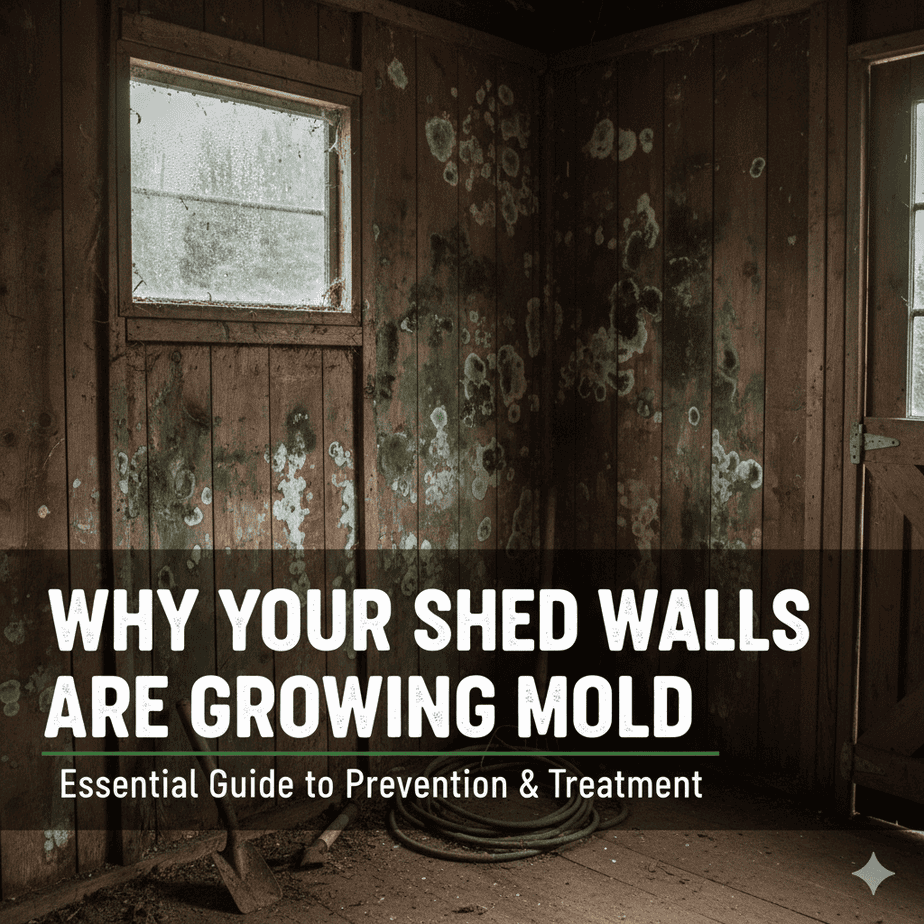
You open the shed door to grab your tools, and a musty, earthy smell hits you. Then you see it: a dark, speckled pattern creeping up the interior walls or a fuzzy white patch in the corner. Mold. It’s more than just an eyesore; it’s a sign that your shed is sick, and it can destroy your belongings and the structure itself.
But why is this happening? Your shed is meant to be a dry, protective space. The answer lies in an invisible battle happening inside your walls, a battle between air, temperature, and moisture. The good news is that you can stop it fast and reclaim your space.

Quick Navigation Menu
Why Your Shed Walls Are Growing Mold
How to Stop Mold From Growing On Shed Walls Fast
3 Advanced Tips to Keep Mold Out of Your Shed
Why Your Shed Walls Are Growing Mold
The Root Cause: It’s All About Condensation
Mold doesn’t grow without moisture. Simply spilling a little water on the floor won’t cause a widespread infestation. The primary culprit is often persistent, unseen condensation.
Here’s the simple science: warm air can hold more moisture than cold air. When warm, humid air comes into contact with a cold surface, the air cools down and can no longer hold all that moisture. The excess water vapor condenses into liquid water on that cold surface.
In a shed, this plays out in a few key ways:
The Uninsulated Shed: On a cool night, the exterior walls and roof of your uninsulated shed become cold. The next morning, warm, humid air from outside seeps in. When that air hits the cold interior surface of the siding or roof, it condenses, soaking the wood framing and anything stored against the walls.
The Insulated (But Improperly Sealed) Shed: This is the most common scenario for major mold growth. The moment you add insulation to a shed, you change the game. If the insulation is installed without a proper vapor barrier, warm, moist air from the daily temperature swings travels through the insulation. When it hits the cold outer sheathing (the backside of your siding), it condenses inside the wall cavity—a dark, enclosed space where it can’t dry out. This is a mold paradise.
Don’t Wait for Mold to Spread — Click Here to Get a Top-Rated Home Test Kit!
How to Stop Mold From Growing On Shed Walls Fast
A Step-by-Step Action Plan
Time is of the essence with mold. Here’s how to tackle the problem immediately and for the long term.
Step 1: The Immediate Triage (Stopping the Active Growth)
Safety First: Wear an N95 mask, gloves, and safety goggles. You do not want to inhale mold spores.
Dry It Out: Get air moving immediately. Place a powerful fan or two inside the shed and open all doors and windows. For severe moisture, a dehumidifier is your best friend. Run it continuously for at least 24-48 hours to suck the ambient moisture out of the air and materials.
Clean the Mold: For non-porous surfaces (metal, plastic) and semi-porous wood, scrub the mold away with a solution of one part white vinegar to one part water, or a commercial mold cleaner. For extensive growth on wood, you may need to use a diluted bleach solution (1 cup bleach to 1 gallon of water), but be cautious as bleach can lighten the wood and doesn’t kill mold roots on porous surfaces. Important: Never paint over mold. It will continue to grow underneath and break through the paint.

Step 2: Diagnose the Moisture Source (The Critical Investigation)
Once the active growth is handled, you must play detective. Why was the moisture there?
Check for Leaks: Inspect the roof, siding, and around windows and doors for any obvious leaks. Water stains are a dead giveaway.
Assess Your Ventilation: Is your shed stifling and airless? Stagnant air holds moisture against cold surfaces. Proper ventilation is key to allowing moist air to escape.
Consider the Interior Moisture: What are you storing? Bags of damp fertilizer, a recently used lawn mower caked in wet grass clippings, or even open containers of water can release a surprising amount of moisture into the air.
Step 3: Implement the Long-Term Cure (The Permanent Fix)
This is where you solve the condensation problem for good. The right solution depends on your shed’s construction.
For an Uninsulated Shed:
Your best defense is ventilation and air gaps.
Install Vents: Add passive ventilation like soffit vents paired with a ridge vent. This creates a natural airflow where cool air enters low and warm, moist air exits high.
Create Air Space: Never store cardboard boxes or wood directly against the walls. Use shelving that allows air to circulate behind it. This simple step prevents the “cold surface” from contacting your belongings and allows moisture to dissipate.
For an Insulated Shed:
This requires a more scientific approach. You must control where the warm, moist air can go. This is where the vapor barrier becomes your most important weapon.
Understand “The Warm Side”: A vapor barrier is a plastic or foil sheet that blocks moisture vapor. It must be installed on the “warm-in-winter” side of the insulation. In almost all climates, this means it goes on the interior side, right after you install the insulation batts and before you put up your interior wall covering (like plywood or drywall).
Find Out What’s Lurking in Your Air — Get an Accurate Mold Test Kit Now!
Seal It Tight: Installing a vapor barrier isn’t like hanging a plastic curtain. Its effectiveness depends on a perfect seal.
Overlap Seams Correctly: Overlap sheets by at least 12 inches and seal them with specialized sheathing tape or UL-approved duct tape designed for this purpose.
Seal All Penetrations: Anywhere a wire, pipe, or light fixture pokes through the barrier, you must meticulously seal around it with acoustic sealant or more tape. A single gap can funnel moist air into the wall, defeating the entire purpose.
Don’t Trap Moisture: If you are adding a vapor barrier to an existing shed, you must be 100% certain the wall cavity is completely dry first. Adding a barrier to a damp wall will simply trap that moisture inside, guaranteeing rot and mold.

3 Advanced Tips to Keep Mold Out of Your Shed
Floor Protection: Don’t forget the floor. Ground moisture is a constant threat. If you’re building new, a polyethylene vapor barrier under a concrete slab is essential. For wooden floors, ensure there is a vapor barrier and adequate cross-ventilation in the crawlspace beneath.
Choose the Right Insulation: While fiberglass batts are common, rigid foam board insulation has a higher inherent resistance to moisture and can be a better choice in damp environments. Some types even have a foil facing that acts as a built-in vapor barrier.
Climate Matters: In hot, humid climates where the air conditioning might run in your workshop, the “warm side” can flip. In these cases, consulting a local builder is wise to ensure your vapor barrier is on the correct side of the insulation.
Your Mold-Free Shed Awaits
Mold in your shed is a warning sign, not a death sentence. By understanding that it’s a symptom of a moisture and condensation problem, you can move beyond simply cleaning the surface and implement a real solution. The formula is simple: Stop the active growth, diagnose the source, and implement a permanent fix centered on proper ventilation or a perfectly sealed vapor barrier.
Take a weekend to tackle this problem. The peace of mind that comes from opening your shed door to a clean, dry, and fresh-smelling space—and knowing your tools and investment are protected—is well worth the effort.
Detect Hidden Mold Fast — Order a Trusted Home Mold Test Kit on Amazon Today!
Related Reading
Is a 6-Mil Plastic Sheet Enough? Comparing Shed Vapor Barrier Materials
Why Cheap Vapor Barriers Fail (and How to Pick One That Lasts)
How to Stop Ground Vapor Damage Before It Starts
Questions and Answers
Question: Why are my shed walls growing mold in the first place?
Answer: Mold typically grows in damp, poorly ventilated areas. In sheds, moisture can accumulate from leaks, condensation, or high humidity, creating the perfect environment for mold spores to thrive on wooden or porous surfaces.
Question: What are the most common causes of mold growth inside sheds?
Answer: The main causes include roof leaks, poor ventilation, water seeping through the floor, condensation from temperature changes, and storing damp items like tools or garden equipment inside the shed.
Question: How can I tell if the mold on my shed walls is dangerous?
Answer: Most shed mold is harmless but can still cause respiratory irritation. Black or dark green mold, however, could indicate toxic species like Stachybotrys chartarum. If the mold covers a large area or has a strong musty odor, it’s best to wear protection or call a professional for removal.

Question: What steps can I take to stop mold from returning after cleaning it?
Answer: After cleaning the mold, improve ventilation by adding vents or windows, use a dehumidifier or moisture absorber, seal any leaks, and repaint the interior with a mold-resistant paint or sealant.
Question: Does the type of shed material affect mold growth?
Answer: Yes. Wooden sheds are most prone to mold because wood absorbs moisture easily. Metal and plastic sheds are more resistant but can still grow mold if condensation forms inside and isn’t properly ventilated.
Question: Can insulation help prevent mold in my shed?
Answer: Insulation helps regulate temperature and reduce condensation, but it must be paired with proper ventilation. Otherwise, trapped moisture behind insulation can actually worsen mold problems.