
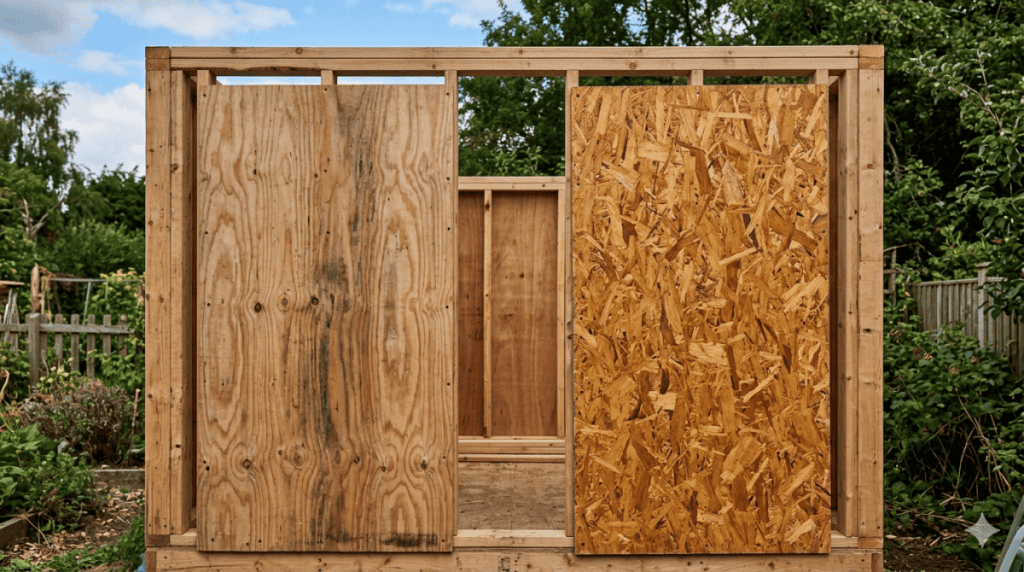
If you are planning to Build a Shed, one of the most important decisions you’ll face is selecting the right material for the walls. The choice between Oriented Strand Board (OSB) and plywood is a classic debate that can significantly affect your project’s budget, durability, and overall success. Both are engineered wood products used for structural sheathing, but their performance, cost, and longevity differ in critical ways. This guide will provide a comprehensive comparison to help you decide which is better for your specific needs.

Quick Navigation Menu
What is Stronger for a Shed, 3/8 in plywood or 3/8 in OSB?
Does OSB Rot Faster Than Plywood on a Shed?
What Lasts Longer on a Shed, Plywood or OSB?
What are The Pros and Cons of OSB for a Shed?
What are the Pros and Cons of Plywood for a Shed?
What is the Best Thickness of OSB for Shed Walls?
What is the Best Thickness of Plywood for Shed Walls?
Which is Cheaper for Shed Walls, Plywood or OSB?
What is More Water-Resistant for Shed Walls, OSB or Plywood?
What is Stronger for a Shed, 3/8 in plywood or 3/8 in OSB?
When comparing 3/8-inch thicknesses, the question of strength is more nuanced than a simple “A is stronger than B.” Both OSB and plywood are recognized by building codes as “wood structural panels,” meaning both are strong enough for use in construction. However, they exhibit different types of strength.
Plywood has a slight edge in shear strength, which is the ability to resist forces that try to make the wall slide or rack. This characteristic makes plywood particularly advantageous in areas prone to high winds or seismic activity. On the other hand, OSB is often considered better suited to handling strain and pressure, excelling in load distribution. Due to its uniform composition, OSB is heavier and denser at the same thickness, offering predictable performance in many structural applications.

Crucially, many construction experts advise against using 3/8-inch thickness for primary shed walls. The general consensus among builders is that 3/8-inch material is too thin for reliable sheathing, with 7/16-inch or 1/2-inch being the preferred minimum. While some shear capacity data shows 3/8-inch wood structural panels can have a higher unit shear capacity (615 plf) compared to 3/8-inch plywood (450 plf) when nailed at 6-inch edge spacing, this doesn’t tell the whole story. For a Building a Shed project, you should view 3/8-inch as an absolute minimum and strongly consider a thicker, more robust panel for the main walls.
Does OSB Rot Faster Than Plywood on a Shed?
The short answer is yes, OSB is generally more susceptible to rot than exterior-grade plywood when exposed to moisture over time. OSB is manufactured from fast-growing wood strands that have a high proportion of sapwood and a lot of exposed end grain, which readily absorbs water. Once water penetrates an OSB panel, the material swells and retains moisture for longer, creating an ideal environment for fungi and rot.
While OSB may absorb water slightly slower than plywood initially, its tendency to dry much more slowly makes it more vulnerable in the long term. Exterior-grade plywood, in contrast, is constructed with waterproof glue and higher-quality wood veneers, which significantly slows down the rotting process. This doesn’t mean plywood is immune to rot—it will eventually succumb—but the consensus is that plywood will last a fair bit longer when repeatedly exposed to wet conditions. For a structure like a shed that is exposed to the elements, this is a vital consideration.
What Lasts Longer on a Shed, Plywood or OSB?
The longevity of either material is almost entirely dependent on the level of protection from the elements. In a perfectly dry environment with a roof that never leaks and walls that never get wet, both materials can last for decades. Some estimates suggest OSB can last between 30 and 60 years if properly maintained, and a shed floor made of OSB has been known to last 15 years with no serious degradation. In certain dry climates, properly sealed OSB might even outperform standard plywood, offering 2-3 years of additional service life.

However, in the real world where moisture is a factor, plywood’s superior ability to handle and recover from water exposure usually gives it a longer service life. Plywood dries more quickly and can return to its original shape, whereas OSB can remain permanently swollen after getting wet. Experts with decades of experience consistently argue that exterior-grade plywood performs better in wet and humid climates, making it the more “forgiving” product overall.
What are The Pros and Cons of OSB for a Shed?
Pros of OSB:
- Cost-Effective: OSB is the budget-friendly champion, consistently being 15-30% cheaper than comparable plywood. For large projects, this can lead to significant savings, a crucial factor when considering the cost to build a shed.
- Large Panel Sizes: OSB panels are available in lengths up to 16 feet, much larger than plywood’s typical 8- to 10-foot limit. This allows you to sheath entire walls with a single sheet, reducing seams and installation time.
- Excellent Uniformity: The manufacturing process results in a dense, consistent panel with no voids. This gives OSB predictable strength and stiffness, making it a great fit for subflooring and wall sheathing.
- Eco-Friendly: Because OSB is made from small, fast-growing trees and utilizes nearly 100% of the log, it is often considered a more sustainable and environmentally friendly option than plywood.
Cons of OSB:
- Moisture Sensitivity: OSB’s main weakness is its vulnerability to water. It swells significantly at the edges when wet and can be permanently damaged by a single rainstorm if left unprotected.
- Heavy and Hard to Cut: OSB is heavier than plywood, often requiring two people to move a single sheet safely. It can also be more difficult to cut, sometimes creating rough edges.
- Slow Drying: While it may resist water ingress initially, OSB holds onto moisture once it gets inside, making it prone to mold, mildew, and rot.
What are the Pros and Cons of Plywood for a Shed?

Pros of Plywood:
- Excellent Water Resistance: Exterior-grade plywood handles moisture far better than OSB. It dries faster, swells less, and can recover from getting wet without permanent damage.
- Superior Nail and Screw Holding Power: The cross-grain construction of plywood provides exceptional holding power for fasteners, ensuring a strong and durable connection for siding and other attachments.
- Better for Tension and Flexing: Plywood is better at handling tension and maintaining strength while being shaped or flexed, making it more resistant to cracking under stress.
- More Forgiving for DIYers: For those learning How to Build a Storage Shed, plywood’s forgiving nature regarding moisture and installation errors makes it a safer and less stressful choice.
Cons of Plywood:
- Higher Cost: Plywood is significantly more expensive. The price difference can be dramatic, with 1/2-inch plywood costing over three times as much as 7/16-inch OSB. This can be a major factor in the cost to build a storage shed.
- Smaller Panels: With a maximum length of 8 to 10 feet, plywood often requires more seams and joints to cover a large wall area, which can increase installation time and material waste.
- Potential for Delamination: Lower-grade plywood can sometimes delaminate (the layers can separate) over time if exposed to extreme moisture, though this is less common with high-quality exterior grades.
What is the Best Thickness of OSB for Shed Walls?

For OSB shed walls, the best and most common thickness is 7/16-inch. This is widely considered the minimum standard for wall sheathing when studs are spaced 16 inches on center (the typical framing standard).
If your shed’s wall studs are spaced 24 inches apart, it’s wise to upgrade to a thicker panel, such as 1/2-inch or 5/8-inch, to prevent the walls from bowing or flexing over time. While 3/8-inch OSB is available, it’s generally too thin for exterior wall sheathing on a shed and should be reserved for non-load-bearing interior applications or gable end walls.
What is the Best Thickness of Plywood for Shed Walls?
The recommended thickness for plywood shed walls is 15/32-inch (often referred to as 1/2-inch). This provides a robust, durable panel with excellent strength and holding power. For the vast majority of How to Build a Shed projects, 15/32-inch plywood is the standard choice.
As with OSB, 3/8-inch plywood is generally considered too thin for primary wall sheathing. It lacks the necessary stiffness and nail-holding capacity for a long-lasting structure. While some codes allow 3/8-inch for gable end walls, it is not recommended for the main load-bearing walls.
Which is Cheaper for Shed Walls, Plywood or OSB?

Without question, OSB is the cheaper option for shed walls. The price gap is substantial and consistent. A standard 4×8 sheet of OSB can cost around $6 to $16, while a comparable sheet of plywood is typically $10 to $23. In general, OSB is approximately 15-30% less expensive than plywood, with some sources suggesting it can be about half the price.
This price difference is the primary reason OSB has become so dominant in residential construction, especially for wall sheathing that will be quickly covered by house wrap and siding. When planning your cost to build a shed, choosing OSB over plywood for the walls can save you hundreds of dollars, especially on a larger structure.
What is More Water-Resistant for Shed Walls, OSB or Plywood?
Plywood is significantly more water-resistant than OSB for shed walls. Exterior-grade plywood’s construction with waterproof glue and its ability to dry out quickly give it a major advantage in wet conditions. It can withstand rain during construction and recover from occasional leaks far better than OSB.
OSB, while fine for enclosed spaces, simply doesn’t “love getting wet”. Its edges are highly absorbent, and once saturated, the panel can swell and lose its structural integrity. For a shed that will be exposed to rain, snow, and humidity, plywood’s superior water resistance is a critical factor for long-term performance.

Conclusion: Making the Right Choice for Your Shed
The answer to the question “OSB vs Plywood for Shed Walls” depends entirely on your budget, your climate, and your skill level. If you are on a tight budget and building in a dry, covered environment, OSB is a strong and cost-effective choice. It’s the go-to material for many contractors Building a Shed because it saves money without sacrificing structural integrity.
However, if you want the most durable, water-resistant, and forgiving material for a long-lasting shed, plywood is the superior product. The higher upfront cost buys you peace of mind, especially if you live in a humid or rainy area. As you research How to Build a Shed, factor in the total cost to build a storage shed and consider that the slightly higher investment in plywood can extend the life of your shed and reduce the risk of costly repairs down the line. For the average homeowner asking, how can I build a shed that will stand the test of time, plywood is almost always the better long-term investment.