
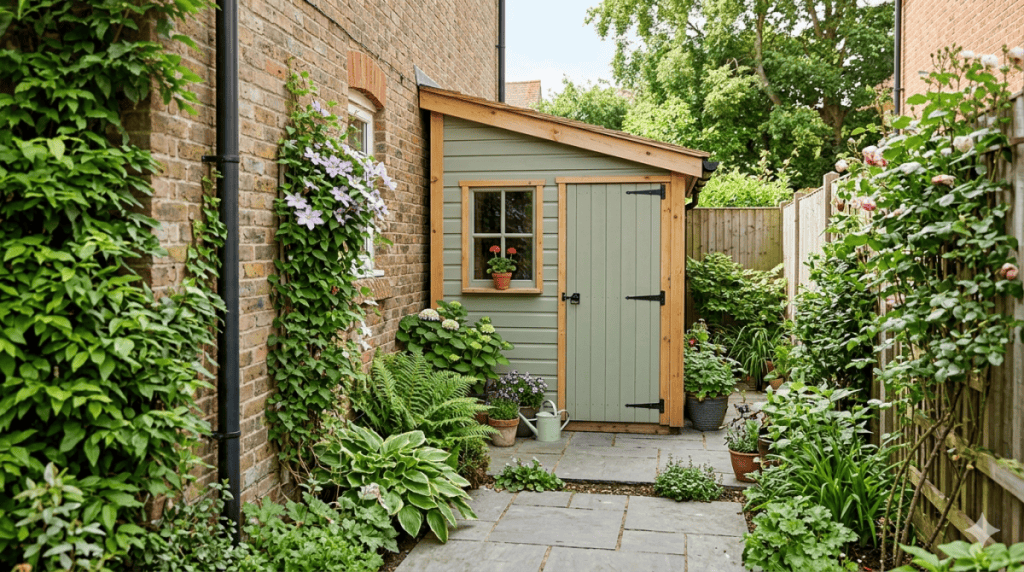
For the longest time, the dream of a backyard shed has been synonymous with the dream of a backyard. We picture a quaint wooden structure nestled in a far corner of a sprawling, manicured lawn, a private retreat for potting plants or storing a riding lawnmower. But what if you don’t have a sprawling lawn? What if your “outdoor space” consists of a cozy patio, a petite urban garden, or a narrow passageway between your home and the fence?
If you’ve been putting off organizing your life because you think you lack the real estate, it’s time to change your perspective. The secret to conquering your clutter and gaining that much-needed functional space isn’t locked away in a backyard you don’t have. It’s been hiding in plain sight, right around the corner: the side yard.

That often-forgotten strip of land, the utility corridor that leads from the front of your house to the back, is arguably the most underutilized square footage on your property. By thinking vertically and choosing the right structure, you can transform this narrow space into a storage powerhouse. But before you start sketching plans for a 12×16 workshop, let’s dig into the details that will make or break your project. The most critical of these details, and the one that will shape every decision you make, is the shed cost.
Quick Navigation Menu
Why Your Side Yard is Your Secret Weapon Shed Build
Breaking Down the Your Shed Cost: What’s the Real Cost?
The Cost to Build a Storage Shed: DIY vs. Kit vs. Custom
Size Matters: From Sliver to Statement
Shed Material: Wood, Metal, or Resin?
The Hidden Half of a Side Yard Shed: Foundation and Permits
Is Building a Shed in a Side Yard Worth It?
Related Reading
I Want a Shed… Now What? How to Start Without Getting Overwhelmed
How Do I Choose the Best Shed Plans? (Paid and Free)
Choosing a Shed Design That Matches Your Skill Level
Planning a Shed Building Timeline That Won’t Break Your Spirit
Choosing the Right Shed Size for Your Yard Size
Why Did My Cheap Shed Cost So Much? — Budgeting the Right Way
Why Don’t My Shed Walls Line Up?
Why Your Side Yard is Your Secret Weapon Shed Build
Ignoring the side yard is a missed opportunity. Often just wide enough for garbage bins or a bicycle, this space is rarely used for much else. However, it possesses a unique advantage: it’s close to the house. This proximity makes it incredibly convenient for storing everyday items like gardening tools, grill accessories, and muddy boots that you don’t want tracking through the kitchen.

To make a side-yard shed work, you must think differently. You aren’t building a traditional barn; you’re building a “lean-to” or a compact, vertical structure. The key is to utilize the height of your home’s exterior wall. By building a shed that attaches directly to your house (or sits very close to it), you create a seamless transition from indoor living to outdoor storage. This design, often called a side-entry or “breezeway” shed, can turn a useless walkway into the most organized part of your property.
Breaking Down the Your Shed Cost: What’s the Real Cost?
So, you’re ready to reclaim your side yard. The next logical question is the hardest to answer with a single number: how much does a shed cost? The truth is, the price tag is a spectrum. As you plan to fit your tools and gear into that tight space, a new shed is a tempting option. However, understanding the financial landscape will prevent sticker shock and help you tailor the project to your budget.
Industry data suggests that the average shed cost to install is about $3,500. But that’s just an average. Depending on your ambitions, you could spend as little as $800 on a basic DIY project, or you could blow past $15,000 on a fully customized mini-studio with electricity and high-end finishes. For a more specific range, most homeowners find themselves somewhere between $1,000 and $18,000.
To get a grip on your specific budget, you need to dissect the primary factors: size, material, and labor. How much does it cost to build a shed really depends on how you answer these three questions.
The Cost to Build a Storage Shed: DIY vs. Kit vs. Custom

When considering the cost to build a storage shed, you generally have three paths you can take, each with vastly different financial and time commitments.
- The Prefabricated Shed Kit
If you’re moderately handy and value your weekends, a kit is your best friend. These are the “weekend warrior” specials. Kits come with pre-cut parts, hardware, and instructions, making them accessible for most homeowners. The price range here is wide, but generally favorable. A small resin or plastic shed kit can cost as little as $350, while larger wooden kits can run up to $4,000 or more.
The beauty of a kit is predictability. You know exactly what you’re getting, and the manufacturer has already figured out the tricky engineering. However, the listed price isn’t the final shed cost. You’ll still need to pay for a foundation (like a gravel pad), and you may need to purchase tools if you don’t already own them.
- The DIY Build from Scratch
For the purist, building from the ground up is the ultimate test of skill. On the surface, it looks like the cheapest route because you’re not paying for a middleman or the “convenience” of a kit. In reality, the cost to build a shedfrom scratch is highly variable and often sneaks up on you.
You’re looking at a cost-per-square-foot range of $10 to $150. For a popular medium size, like a 12×12, the material cost to build a shed yourself typically lands between $2,000 and $4,500. This covers lumber, roofing, siding, and fasteners.
But the hidden costs are where DIYers get tripped up. If you need to buy power tools (circular saw, nail gun, etc.), you could easily add $500 or more to your budget. Then there’s the “trip tax”—the inevitable five trips to the hardware store for things you forgot, which adds both time and gas money. And remember, one wrong cut on a sheet of plywood is money in the trash.
- The Custom-Built Professional Job
If your side yard has odd dimensions, if you want a live-in studio, or if you simply don’t want to swing a hammer, hiring a professional is the way to go. This is the high-end of the market. You’re paying for expertise, speed, and a guarantee that the structure will last.
A professional build ensures the structure is sound and compliant with local codes. For that 12×12 shed, hiring a contractor will likely push your total cost to build a storage shed to somewhere between $3,000 and $8,000, or even higher in urban areas with premium labor rates. This figure usually includes site prep, foundation, framing, and finishing, taking the guesswork completely out of your hands.
Size Matters: From Sliver to Statement

Your side yard likely dictates your size, but let’s look at how size impacts the wallet.
- Small (6×8 or 8×10): Perfect for the narrow side yard. These are for basic tool storage, bikes, and gardening gear. A small plastic shed might cost $300-$800, while a wooden one could be $900-$1,600.
- Medium (10×12 or 12×16): This is the sweet spot for most homeowners. You can fit a lawn tractor, a workbench, and still have room to move. A 10×12 might run $1,300-$2,200, while a 12×16 (great for a workshop) jumps to $2,100-$3,200. The cost to build a shed of this size is where you really need to compare kit vs. custom pricing.
- Large (20×20+): At this point, you’re essentially building a small garage. If you have a side yard that can accommodate this, you’re looking at $5,200 to over $14,000. This is serious construction territory.
Shed Material: Wood, Metal, or Resin?
The material you choose dramatically affects the final shed cost, as well as the longevity and look of your build.
- Wood: The classic choice. It looks beautiful, can be painted to match your house, and is infinitely customizable. However, wood requires maintenance (sealing, painting) to prevent rot and pests. It sits in the mid-to-high range of the price spectrum.
- Metal: Durable, fire-resistant, and low-maintenance. Metal sheds are great for security and stand up to harsh weather. The downside? They can turn into an oven in direct sunlight and may dent or rust over time if the coating is scratched .
- Plastic/Resin: The budget-friendly and easy option. These sheds are lightweight, rot-proof, and incredibly easy to assemble. They are perfect for the side yard because they are often narrow and tall. However, they might not be as sturdy as wood or metal, and they can be susceptible to wind damage if not anchored properly.
The Hidden Half of a Side Yard Shed: Foundation and Permits
When asking how much does it cost to build a shed, many first-timers forget what happens before the walls go up. A solid foundation is non-negotiable. It keeps your shed level, dry, and stable. A gravel base is the most economical for a smaller shed, costing a few hundred dollars. A poured concrete slab for a medium-sized shed, however, can cost $1,000 to $2,000.
Then there is the “red tape” budget. You must check local regulations before you buy a single nail. Many municipalities require permits for structures over a certain square footage, and they have “setback” rules that dictate how close you can build to the property line—a critical detail for a side yard build. Permit fees for a shed are generally manageable, often ranging from $50 to $145, but failing to pull one can result in fines or being forced to tear down your new building.

Is Building a Shed in a Side Yard Worth It?
So, you look at that narrow strip of grass by your fence, and you do the math. You tally up the shed cost, the labor, the permits, and the foundation. Is it worth it?
Absolutely. When you lack a backyard, every square inch counts. Building a shed in your side yard isn’t just about storage; it’s about reclaiming your garage for your car, clearing out your basement, and adding value to your home. A well-built shed is a long-lasting asset that enhances your property’s functionality and curb appeal.
The secret is out. Don’t look past that skinny strip of land. With smart planning and a realistic budget, your side yard can hold the shed of your dreams. Whether you opt for a $400 resin kit or a $10,000 custom studio, the return on investment—in terms of organization, space, and sanity—is immeasurable.