
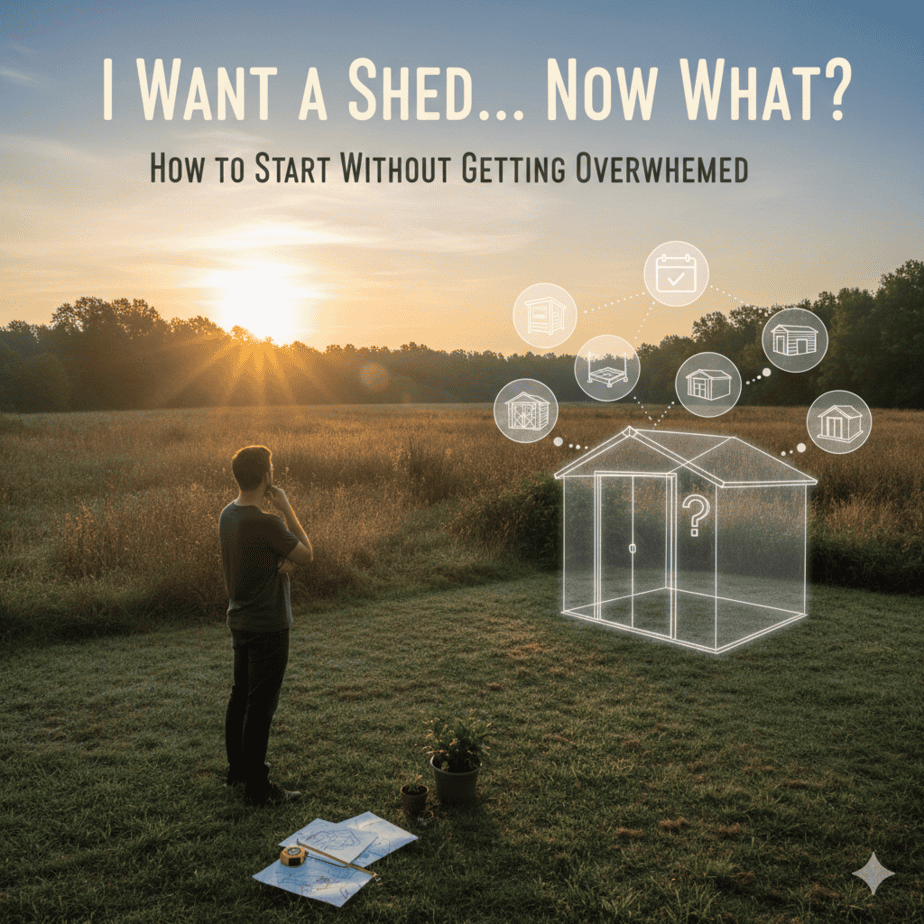
That feeling hits you like a spring breeze: I want a shed. Maybe your garage is overflowing with lawn equipment and holiday decorations. Perhaps you dream of a quiet studio for your art, a tucked-away workshop for your tools, or simply a clean, organized space to call your own.
The vision is clear, a charming little structure at the back of your garden. But then, reality comes knocking. Permits? Foundations? Materials? Costs? The dream suddenly feels like a fast track to overwhelm.
Breathe. Every majestic shed, from the humble lean-to to the glorious she-shed, started exactly where you are now: at the beginning. The journey from “I want a shed” to turning the key in your new shed door is a series of manageable, logical steps. This guide is your roadmap, designed to break down the process, dispel the anxiety, and help you start… and finish, your shed project with confidence.

5 Steps to Build a Shed Without Getting Overwhelmed
Quick Navigation Menu
Step 1: The Dreaming & Planning Phase (Before You Buy a Single Nail)
Step 2: The Design & Procurement Phase (Choosing Your Path)
Step 3: The Groundwork Phase (A Solid Foundation is Everything)
Step 4: The Construction Phase (One Piece at a Time)
Step 5: The Finishing Touches Phase (Making It Yours)
Conquering the Overwhelm: Your Mindset Toolkit
Related Reading
Choosing a Shed Design That Matches Your Skill Level
How Do I Choose the Best Shed Plans? (Paid and Free)
Planning a Shed Building Timeline That Won’t Break Your Spirit
Choosing the Right Shed Size for Your Yard Size
Dealing With Neighborhood Shed Rules: Your Guide to a Hassle-Free Build
Building a Shed as a Homeowner? Avoid These Costly Legal Mistakes
Why Did My Cheap Shed Cost So Much? — Budgeting the Right Way
Why Don’t My Shed Walls Line Up?
Step 1: The Dreaming & Planning Phase (Before You Buy a Single Nail)
This is the most critical phase to prevent overwhelm. Rushing to the hardware store is a recipe for wasted money and frustration.
Define Your “Why” with Precision: Go beyond “storage.” What exactly will go inside? List every item. This isn’t pedantic; it’s essential for determining size. A lawnmower, bicycle, and garden tools need a very different space than a potting bench, a wall of shelves for clay pots, and a rocking chair. Will it be a pure utility space, or a retreat? Your “why” dictates everything.
The Goldilocks Size Quest: With your list in hand, you can size your shed. A common mistake is building too small. Use painter’s tape or a garden hose to mark out potential dimensions on your lawn. Walk inside the imaginary space. Can you move around comfortably? Think in 2-foot increments: 8×8, 10×12, 12×16. Remember, consider not just floor space, but wall height for shelving and loft potential. Always add 20% to your initial size estimate—you’ll fill it.
Location, Location, Location: Where will it live? Consider sun exposure, drainage (you want it on high ground), access (can you get large sheets of plywood to the site?), and proximity to trees (falling limbs, leaf litter). Don’t forget about your future self: is the path to the shed easily navigable in the rain or snow?
The Invisible Rulebook: Codes and Covenants: This is the step most likely to cause a major headache if skipped. You must investigate two things:
Local Building Codes: Contact your city or county building department. Many require a permit for sheds over a certain square footage (often 100 or 120 sq. ft.). They will have rules about “setbacks” (how far the shed must be from property lines, your house, and easements), and may require specific foundation types or even electrical inspections if you wire it.
Homeowners Association (HOA) Rules: If you have an HOA, their rules can be even more restrictive than city codes. They may dictate acceptable siding, roof styles, colors, and placement. Get approval in writing.
Budgeting Beyond the Kit Price: Your budget is more than the cost of a kit or the lumber pile. Create a realistic line-item list: permit fees, concrete or foundation blocks, lumber, siding, roofing, doors, windows, hardware, paint/stain, delivery charges for materials, and tool rentals (or purchases). Add a contingency fund of 15-20% for the inevitable surprises.
Step 2: The Design & Procurement Phase (Choosing Your Path)
Now you know what you need, where it can go, and what it will roughly cost. It’s time to choose your building path.

Path A: The Pre-Fab Kit
Pros: Incredibly low overwhelm. Everything is pre-cut and engineered. Instructions are included. It’s fast(er).
Cons: Less customization. Material quality can be variable. The sense of accomplishment is different.
Best for: Those who want the simplest, fastest route and are comfortable with assembly-line instructions.
Path B: The Custom Build from Plans
Pros: Total control over design, size, materials, and quality. Immense personal satisfaction. Can often be cheaper than a kit for the same size.
Cons: Requires more time, more planning, and intermediate DIY skills (or a willingness to learn).
Best for: The hands-on dreamer who wants a perfect fit and enjoys the process.
Path C: Hiring a Pro
Pros: Hands-off. High-quality result. Done quickly and correctly.
Cons: The most expensive option.
Best for: Those with the budget who lack the time, skill, or desire to DIY.
If you choose Path A, research kit companies thoroughly. Read reviews about material quality and clarity of instructions. If you choose Path B, source reliable plans from reputable websites, books, or magazines. A good plan includes a detailed materials list, cutting diagrams, and step-by-step instructions.
Gather Your Tools and Tribe: Take inventory of your tools. For a shed build, you’ll likely need: a circular saw or miter saw, a drill/driver, a level (a long 4-foot level is invaluable), a tape measure, a hammer, a square, safety glasses, and gloves. Plan for tool rentals for bigger tasks like mixing concrete. Also, think about your “tribe.” Do you have a friend or family member who can help on foundation day or raising walls? Having a helper for key steps is a game-changer.
Step 3: The Groundwork Phase (A Solid Foundation is Everything)
You can build a beautiful shed on a bad foundation, but it won’t last. This phase is about patience and precision.

Site Preparation: Clear the area of all grass, weeds, and debris. You want bare earth. Use your level over a long board to gauge the slope. A perfectly level site is the goal.
Choosing Your Foundation:
Concrete Slab: Permanent, level, and great for heavy loads or finished floors. Requires forming, gravel base, rebar, and pouring concrete. Highest cost and skill requirement.
Gravel Base with Skids: A fantastic DIY option. Involves digging shallow trenches, filling with compacted gravel, and laying pressure-treated timber “skids.” The shed floor frame is then built on these skids. Offers good drainage and is adjustable.
Concrete Piers/Blocks: Simple and common. Concrete blocks are placed on leveled, compacted gravel at key points under the floor frame. Must be meticulously leveled. Best for smaller sheds on stable ground.
Whichever you choose, take your time with the level. Check, re-check, and check again. Every imperfection in the foundation magnifies itself up through the walls and roof.
Step 4: The Construction Phase (One Piece at a Time)
This is where you see your vision materialize. The key to avoiding overwhelm here is to see the shed not as a monolithic project, but as a sequence of small, achievable projects.

– The Floor Frame: Build a sturdy, square floor frame (often called a “deck”) on your foundation. Squareness is critical. Use the 3-4-5 triangle method to check corners. Attach the plywood floor sheeting securely.
– The Wall Framing: Construct each wall (front, back, sides) flat on the deck or ground. Frame out your door and windows. This is easier than trying to frame them in place. With help, lift each wall into position, brace them plumb (perfectly vertical), and nail them together at the corners and to the floor.
– The Roof Structure: This intimidates many, but it’s just geometry. For a simple gable roof, you’ll build triangular “trusses” or frame a ridge board with rafters. Follow your plans carefully. The trick is consistent cuts and ensuring the ridge is level. Once the rafters are up and sheathed with plywood, you’re officially “dried in”—a major milestone!
– The Skin: Siding and Roofing: Now you weatherproof it. Install your chosen siding (lap siding, plywood, vinyl) from the bottom up. Then, roll out roofing felt (tar paper) over the roof sheathing, and install your roofing material—asphalt shingles being the most common. Overhang and flashing around the roof edges are crucial for shedding water.
– Doors & Windows: Install the pre-hung door and windows according to manufacturer instructions. Proper flashing around these openings is non-negotiable to prevent leaks. This is a satisfying step—it starts to look like a real building!
Step 5: The Finishing Touches Phase (Making It Yours)
The structure is complete. Now, you personalize and protect it.
Paint or Stain: Protect your wood siding and trim with a quality exterior paint or stain. This adds years to your shed’s life and makes it a charming feature of your garden.
Interior Fit-Out: This is where your “why” comes full circle. Install shelving, pegboard for tools, a workbench, or cozy furniture. Think about lighting—a simple battery-powered LED shop light or a solar-powered fixture can make a huge difference.
The Final Landscape: Add functional and beautiful touches around your shed. A stone or paver pathway. A rain barrel at the downspout. Some flower boxes under the windows. This integration makes the shed look like it belongs.

Conquering the Overwhelm: Your Mindset Toolkit
Throughout this process, your greatest tool isn’t your saw; it’s your mindset.
Embrace the Learning: You will make mistakes. A carpenter’s pencil has an eraser for a reason. View each hiccup as part of the education.
Break It Down: Look at your plan and break it into daily or weekly goals. “Today, I build the floor frame.” Celebrate each completion.
Ask for Help: Can’t figure out a rafter angle? The community at your local hardware store or on reputable DIY forums is an invaluable resource.
Keep the Vision Alive: When you’re sore and frustrated, look at the pictures that inspired you. Remember the feeling you’re building toward—the peace of an organized garage, the creativity of your studio.
Building a shed is a profound act of creating something tangible. It’s a series of logical, achievable steps. By starting with a plan, respecting the process, and tackling one task at a time, you move steadily from the overwhelming question of “Now what?” to the incredibly satisfying statement of “I built that.” So, take that first step. Define your dream. Sketch it out. The path to your perfect shed is waiting, and it’s far less daunting than it looks.