
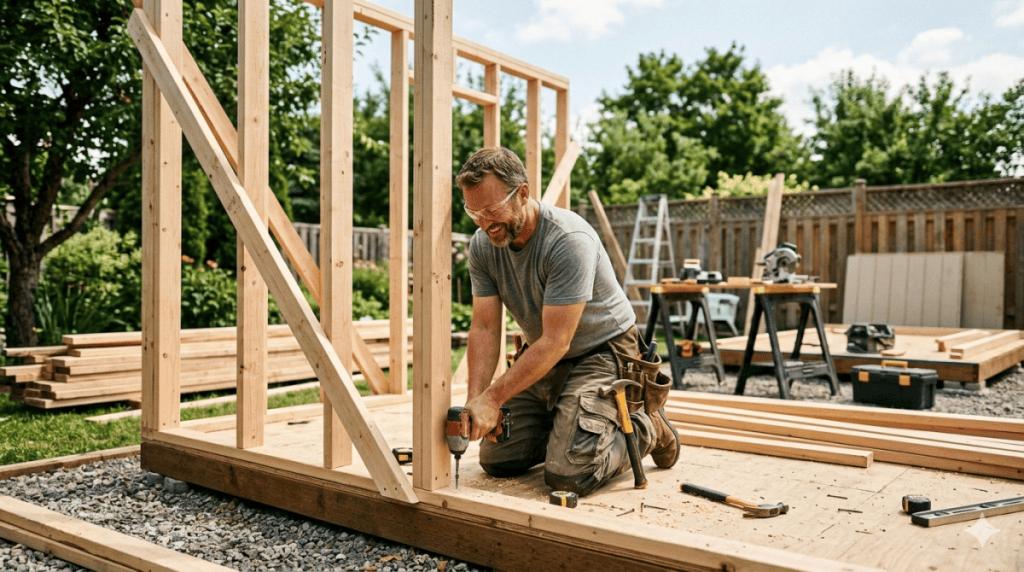
If you’ve ever started building a shed, you know the excitement that comes with imagining the finished space. Maybe it’s a place to store tools, protect lawn equipment, or even create a small workshop. But once you begin planning the structure, many DIY builders quickly realize that framing the walls can feel confusing.
Between choosing lumber sizes, spacing studs correctly, and deciding what wall materials to use, it’s easy to feel overwhelmed. The good news is that building shed walls doesn’t have to be complicated. With the right approach and a few practical tips, you can frame solid, durable walls without turning your project into a stressful experience.
Whether you’re researching how to build a shed, planning your first storage shed, or simply asking yourself, “How can I build a shed that lasts for years?”, this guide will walk you through the essentials of building shed walls the smart way.
By the end of this article, you’ll understand the best materials, stud spacing, sheathing options, and common mistakes to avoid when you build a shed.

How to Build Shed Walls Without Losing Your Mind (Beginner Friendly)
Quick Navigation Menu
Understanding Shed Wall Framing
Should I Use 2×4 or 2×6 for Shed Walls?
What is the Cheapest Way to Build a Shed Wall?
What is the Best Material for Shed Walls?
Is plywood or OSB Better for Shed Walls?
How Far Apart are Studs in a Shed?
How Many 2x4s Do I Need to Build a 10×10 Shed?
What Can I Put on My Shed Walls Instead of Drywall?
How Thick Should OSB be for Shed Walls?
What are the Common Mistakes Made When Framing a Shed Wall?
Simple Step-by-Step Guide to Building Shed Walls
Understanding Shed Wall Framing
Before diving into specific materials and measurements, it’s helpful to understand how shed walls are structured.
Most sheds use a simple wall framing system, similar to residential construction but on a smaller scale.
A typical shed wall consists of:
Bottom plate – the horizontal board that sits on the shed floor
Top plate – the board that connects the tops of all studs
Vertical studs – the framing pieces that give the wall its strength
Wall sheathing – panels like plywood or OSB attached to the outside
When people research how to build a storage shed, they often focus on roofing or flooring first. But the walls are what hold the entire structure together, support the roof, and provide protection from the elements.
Getting the wall framing right will make the rest of the project much easier.
Should I Use 2×4 or 2×6 for Shed Walls?
One of the most common questions when learning how to build a shed is whether you should frame the walls with 2×4 or 2×6 lumber.

For most sheds, 2×4 studs are the standard choice.
2×4 lumber works well for sheds because:
– They are more affordable
– They are lighter and easier to work with
– They provide plenty of strength for small structures
Most backyard sheds ranging from 8×8 to 12×16 are framed using 2×4 studs spaced 16 inches apart.
There are a few situations where 2×6 framing might be worth considering:
– If you want extra insulation
– If you’re building a large workshop-style shed
– If the shed will support heavy roof loads
For the majority of DIY builders working on building a shed for storage, 2×4 studs are perfectly adequate and much more budget-friendly.
What is the Cheapest Way to Build a Shed Wall?
When people ask “How can I build a shed on a budget?”, they’re usually looking for ways to reduce material costs without sacrificing durability.
The cheapest way to wall a shed is to combine affordable framing lumber with cost-effective sheathing materials.
Budget-friendly wall options
– OSB (Oriented Strand Board): This is one of the cheapest and most commonly used shed wall materials.
– T1-11 siding panels: These panels act as both sheathing and siding, reducing labor and material costs.
– Rough plywood siding: Sometimes slightly more expensive than OSB but still affordable.
Tips to save money when building shed walls
If you’re trying to build a shed without overspending, consider these strategies:
– Buy lumber in bulk
– Watch for sales at hardware stores
– Use standard stud spacing
– Choose panel siding that eliminates the need for additional siding layers
Keeping the design simple is often the best way to save money when building a shed.
What is the Best Material for Shed Walls?
The best wall material depends on three factors:
– Budget
– Weather exposure
– How long you want the shed to last
Some materials offer better durability, while others are more affordable.
Common shed wall materials
– T1-11 plywood siding: This is one of the most popular materials used when people build a shed. It combines structural strength with a finished appearance.
– OSB panels: Often used as wall sheathing under siding.
– Exterior plywood: Strong, durable, and resistant to moisture when properly sealed.
– Vinyl or wood siding over sheathing: Used when building higher-end sheds.

Best overall choice
For most DIY builders learning how to build a storage shed, T1-11 siding panels are often considered the best option because they:
– Provide structural strength
– Look good
– Install quickly
– Are relatively affordable
Is plywood or OSB Better for Shed Walls?
Both plywood and OSB are commonly used when building a shed, but they have slightly different advantages.
OSB (Oriented Strand Board)
OSB is made from compressed wood strands bonded with resin.
Benefits include:
– Lower cost
– Widely available
– Consistent strength
However, OSB can absorb moisture more easily, which may cause swelling if it’s not sealed properly.
Plywood
Plywood is made from layers of wood veneer glued together.

Benefits include:
– Better moisture resistance
– Stronger nail-holding ability
– Greater durability over time
The downside is that plywood is usually more expensive.
Which one should you choose?
If you’re trying to build a shed on a budget, OSB is a perfectly acceptable option.
If durability and moisture resistance are your priority, plywood is the better choice.
How Far Apart are Studs in a Shed?
Stud spacing is an important part of wall framing. It affects the strength of the wall and how well the sheathing panels fit.
Most sheds use 16-inch stud spacing, measured on center.
What “on center” means
When studs are spaced 16 inches on center, the distance from the center of one stud to the center of the next stud is 16 inches.
This spacing works well because:
– It provides strong structural support
– Standard 4×8 wall panels fit perfectly
– It distributes weight evenly
Alternative spacing
Some smaller sheds use 24-inch spacing, but this is less common because it creates weaker walls.
If you’re new to how to build a shed, sticking with 16-inch stud spacing is the safest and easiest choice.
How Many 2x4s Do I Need to Build a 10×10 Shed?
Material planning is a big part of building a shed. Running out of lumber halfway through framing can slow down your project.

Let’s look at a basic estimate for a 10×10 shed.
Step 1: Calculate wall perimeter
A 10×10 shed has a perimeter of:
10 + 10 + 10 + 10 = 40 feet
Step 2: Determine stud count
With studs spaced 16 inches on center, you’ll need about:
30–32 wall studs
Step 3: Add plates and extras
You’ll also need additional 2x4s for:
– Bottom plates
– Double top plates
– Door framing
– Window framing
– Extra bracing
Estimated total
Most 10×10 sheds require 45 to 55 2×4 boards depending on the design.
Planning ahead makes the process of how to build a storage shed much smoother.
What Can I Put on My Shed Walls Instead of Drywall?
Drywall is rarely used in sheds because it’s not moisture resistant and can be easily damaged.
Instead, builders often choose more durable wall finishes.

Popular alternatives to drywall
Plywood wall panels
Strong, durable, and easy to install.
OSB interior panels
Affordable and functional for storage sheds.
Pegboard panels
Great for organizing tools in a workshop shed.
Shiplap or wood boards
Adds a rustic or decorative look.
Metal wall panels
Extremely durable and easy to clean.
When planning how to build a shed, think about how you’ll use the space. Tool storage sheds often benefit from plywood or pegboard walls because you can easily hang shelves and hooks.
How Thick Should OSB be for Shed Walls?
Choosing the correct thickness for wall sheathing helps ensure your shed stays sturdy over time.
For most sheds, the recommended thickness is:
7/16 inch OSB
This thickness provides:
– Good structural strength
– Proper nail holding
– Compatibility with standard framing

For larger sheds or buildings in areas with heavy wind or snow, you might choose 1/2 inch plywood for additional strength.
When people ask how can I build a shed that lasts for years, using the proper sheathing thickness is an important step.
What are the Common Mistakes Made When Framing a Shed Wall?
Even experienced DIY builders sometimes make mistakes during wall framing. Avoiding these errors will make building a shed much easier.
Incorrect stud spacing
Improper spacing can cause problems when attaching sheathing panels. Always measure carefully.
Crooked wall framing
Walls should be square and straight before attaching panels.
Forgetting to frame doors and windows properly
Openings need additional support such as headers and jack studs.
Not checking for square
Before securing a wall permanently, measure diagonally across the frame to ensure it is square.
Using warped lumber
Twisted boards can cause uneven walls and alignment problems.
Avoiding these mistakes will help ensure your shed walls are strong and easy to assemble.
Simple Step-by-Step Guide to Building Shed Walls

If you’re still wondering how to build a storage shed, here is a simplified wall framing process.
Step 1: Cut your plates
Cut the top and bottom plates to match the length of each wall.
Step 2: Mark stud locations
Mark stud positions every 16 inches along the plates.
Step 3: Attach studs
Nail or screw the studs between the plates.
Step 4: Frame openings
Add door or window framing if needed.
Step 5: Square the wall
Measure diagonally to ensure the wall frame is square.
Step 6: Install sheathing
Attach OSB or plywood panels to the outside of the frame.
Step 7: Raise the wall
Lift the wall into position and secure it to the shed floor.
Repeat this process for all four walls and your shed structure will quickly take shape.
Final Thoughts
Learning how to build a shed may seem intimidating at first, but framing shed walls is actually one of the most straightforward parts of the project once you understand the basics.
By choosing the right materials, spacing studs correctly, and avoiding common mistakes, you can build strong walls that will support your shed for many years.
Remember these key tips when building a shed:
– Use 2×4 studs spaced 16 inches apart
– Choose OSB or plywood sheathing
– Consider T1-11 siding for easy installation
– Plan your materials before starting
– Always check walls for square
If you take your time and follow a clear plan, you’ll discover that building a shed can be an enjoyable and rewarding DIY project. And before long, you’ll be standing in front of a solid structure that you built yourself — proof that learning how can I build a shed is easier than most people think.