
Building a shed is one of the most popular DIY projects for homeowners across North America. Whether you need a place for your gardening equipment, a workshop for your hobbies, or just a way to declutter the garage, a new shed is a fantastic investment.
When you search for “how to build a shed,” the internet is flooded with tutorials on framing, roofing, and fitting out the interior. However, amidst all the advice on materials and design, there is one crucial aspect that is often overlooked: the legal side of construction.
Before you gather your tools and price up lumber from the home center, it is vital to understand that building a shed is not just a matter of dropping a structure on your grass. Municipalities, homeowner associations (HOAs), and local governments have strict rules regarding these “accessory structures.” Ignoring them can turn a satisfying weekend project into a financial and legal nightmare.

If you are planning to build a shed in the U.S. or Canada, you need to be aware of the hidden legal pitfalls. This guide will walk you through the most common and costly legal mistakes homeowners make on both sides of the border, and how you can avoid them.
Avoid These 7 Costly Legal Mistakes When Building a Shed
Quick Navigation Menu
1] Ignoring the Permit Process
2] Boundary and Setback Mistakes
4] Overlooking Easements and Utilities
5] Ignoring Protected Areas and Environmental Rules
6] Disregarding Building Codes and Structural Integrity
Conclusion: Measure Twice, Build Once
Related Reading
I Want a Shed… Now What? How to Start Without Getting Overwhelmed
How Do I Choose the Best Shed Plans? (Paid and Free)
Choosing a Shed Design That Matches Your Skill Level
Planning a Shed Building Timeline That Won’t Break Your Spirit
Choosing the Right Shed Size for Your Yard Size
Why Did My Cheap Shed Cost So Much? — Budgeting the Right Way
Why Don’t My Shed Walls Line Up?
1] Ignoring the Permit Process
The most frequent and expensive mistake homeowners make is assuming their project is too small to require permission. It is a common thought process: “It’s just a shed, why would the government care?” However, the answer is rarely that simple.
Whether you ask, “how can I build a shed without getting in trouble?” the answer almost always starts with your local planning or building department. Permit requirements vary wildly depending on where you live.
In the United States: Regulations are typically based on the International Residential Code (IRC). Many municipalities, like Wheaton, Illinois, do not require a permit for sheds under 120 square feet. However, this is not a universal rule.
In Boulder County, Colorado, you can build a shed up to 120 square feet without a permit, but there are also limits on how many sheds you can have based on your lot size. Portland, Oregon, sets the threshold at 200 square feet for non-habitable structures. You must always check your local city or county website.
12,000 “Perfect” Shed Plans So Clear, So Complete, So Easy To Use… The Shed Practically Builds Itself… Check Them Out Here
In Canada: The thresholds are often based on square meters. In Burlington, Ontario, you need a permit if your shed exceeds 15 square meters (approx. 161 square feet), is over one story, or contains any plumbing. Similarly, Nanaimo, British Columbia, requires a permit for any accessory building over 10 square meters (approx. 107 square feet). However, in Brooks, Alberta, the threshold is also 10 square meters, but they also regulate how close the shed can be to other buildings.
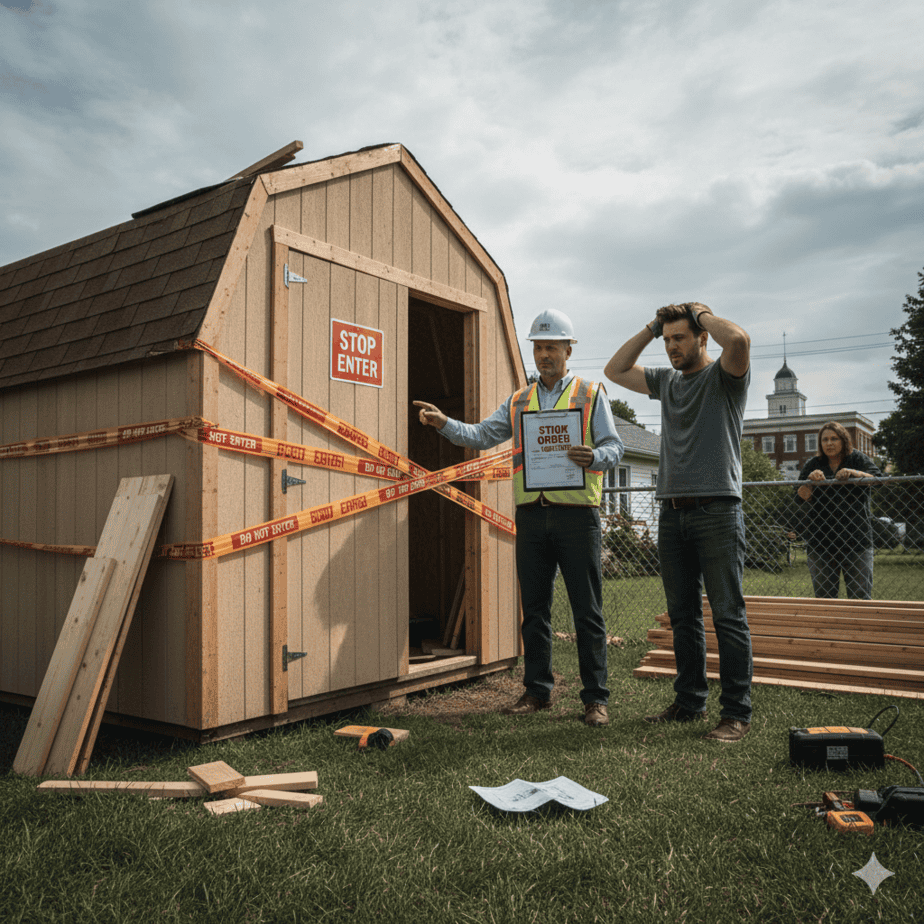
The consequences of skipping this step are severe. In many jurisdictions, building without a permit can lead to fines, a stop-work order, or even an order to tear down the structure entirely. If you are thinking about how to build a storage shed that lasts, start by building a paper trail with your local building department, not with a shovel.
2] Boundary and Setback Mistakes
Once you have established that you need a permit (or even if you don’t), the next hurdle is physical placement. You cannot simply build at the edge of your property. There are strict rules regarding “setbacks”—the distance your shed must be from the property line. This is a critical component of how to build a shed legally.
US Examples: In Wheaton, IL, a shed must generally be at least 3 feet from the side property line and 5 feet from the rear line, but this can vary based on where the shed is placed on the lot. Fairfax County, VA, has a unique tiered system: sheds under 8.5 feet tall can be placed right on the property line, while those between 8.5 and 12 feet must be 5 feet back.
Canadian Examples: In St. Albert, Alberta, accessory buildings must be at least 1 meter (about 3.3 feet) from the side and rear property lines. In Brooks, Alberta, sheds over 10 square meters must also be 1 meter from property lines, while smaller sheds on temporary foundations have no setback requirement.

Before you break ground, you must have a site plan. This is a drawing that shows your house, your proposed shed, your property lines, and the distances between them. Most permit applications will be rejected immediately if this information is missing.
3] The “Intended Use” Trap
One of the grayest areas of shed law is the intended use. When you build a shed, the law views it as an “accessory building”—something incidental to the main house. It is for storing garden tools, bicycles, or maybe a lawnmower.
However, as more people embrace remote work and look for extra living space, sheds are being upgraded. They are becoming home offices, gyms, and even guest bedrooms. This is where you run into trouble.
In Portland, Oregon, the regulations are very clear: a building permit is required for any habitable space, regardless of size. If you add insulation, electricity, and plumbing to make the space habitable, you are no longer building a shed; you are building a dwelling. The City of Nanaimo distinguishes between “Accessory Dwelling units” (like laneway houses or garden suites) and “Accessory Non-Dwelling buildings” (like storage sheds.
Trying to use a storage shed as a living space violates the building code, voids your home insurance, and can lead to significant liability issues. If you are searching for “how to build a storage shed,” keep it a storage shed. If you need a home office, look into the specific codes for “Accessory Dwelling Units” (ADUs) in your area.
4] Overlooking Easements and Utilities
Another critical mistake when planning how to build a shed involves what lies beneath your land. Just because you own the surface doesn’t mean you have the right to build over everything underneath it.
An easement is a legal right for someone else (usually a utility company or a government body) to use a portion of your property for a specific purpose. Common examples include sewer lines, water mains, gas lines, and drainage channels.
Building a shed over a utility easement is a recipe for disaster. In Wheaton, IL, sheds are prohibited from being located within a utility or drainage easement unless written approval is granted by the utility companies. Similarly, St. Albert warns that buildings must not be built over utility right-of-ways.
Click here to get over 12,000 Shed Plans. Download now before the offer ends
Before you finalize your site plan, you must conduct a title search or refer to your plat of survey to locate any easements on your property. The cost of a survey is minuscule compared to the cost of demolishing a finished shed to access a broken water main.
5] Ignoring Protected Areas and Environmental Rules
If your property is located in a special zone, the rules for building a shed become exponentially stricter.
In Portland, if your site slope exceeds 20%, you may need a geotechnical engineering report. If your property is in a flood hazard area, you need to consult with site development staff. In Boulder County, your shed must not violate the conditions of any existing land use approval or conservation easement.
In Canada, properties within Conservation Halton or Niagara Escarpment Commission boundaries require additional approvals beyond the municipal building permit. Always check with your local planning department to see if your property has any “overlays” or special designations.
6] Disregarding Building Codes and Structural Integrity
Getting a permit isn’t just about paying a fee; it is about passing inspections. Many DIYers assume that since they are building a shed, they can use any old construction method. However, you must comply with the building code.
Foundations: In Wheaton, IL, sheds must be anchored to resist wind loads. This can be achieved with a 4-inch thick slab, concrete piers buried 42 inches deep (for frost protection), or mechanical ground anchors. In Canada, foundation details are a key part of the permit application.
Materials: If you use “innovative materials” like composite decking in Burlington, you may need special approval from the Canadian Construction Materials Centre (CCMC).
Electrical Work: If your shed has electricity, it must meet the electrical code. In Wheaton, you need to provide a complete electrical plan showing wiring types, conduit sizes, and grounding methods.

If you are going to build a shed yourself, you are allowed to act as your own designer in some jurisdictions , but you are still responsible for meeting the Code. If you fail an inspection, you may have to tear apart your work to prove it is safe.
7] Lot Coverage and HOA Rules
Finally, there is a limit to how much of your land you can cover with buildings. It is not just about the shed’s size relative to the boundary, but relative to your house and yard.
In St. Albert, the maximum total area of your lot that can be covered by all buildings is 42%. In Brooks, the maximum lot coverage for all accessory buildings combined is 15%. In Wheaton, sheds cannot exceed 5% of the maximum lot coverage for the zone.
Furthermore, if you live in a community with a Homeowner’s Association (HOA), you must also comply with their Covenants, Conditions, and Restrictions (CC&Rs). These are often stricter than municipal bylaws. For townhomes in Wheaton, an approval letter from the HOA is required before a permit can be issued.
Now You Can Build ANY Shed In A Weekend Even If You’ve Zero Woodworking Experience! Watch Free Video Here
Conclusion: Measure Twice, Build Once
The dream of building a shed is a great one. It adds value, organization, and functionality to your home. However, the excitement of the project should not blind you to the legal landscape in which you are building.
To avoid the heartbreak of fines, lawsuits, or demolition orders, remember these key steps before you build a shed:
– Visit Your Local Building Department Website or Office: Do not rely on advice from internet forums. Find the official permit requirements for your specific address.
– Check Your Property’s Status: Look for conservation areas, flood plains, and easements on your plat of survey.
– Draft a Site Plan: Measure your property lines and calculate the setbacks accurately.
– Define the Use: Be honest about whether the shed is for storage or living. If it is for living, you need a different permit.
– Check with Your HOA: If applicable, get written approval before you start.
By taking the time to navigate the legal requirements first, you ensure that when you finally learn how to build a storage shed and swing that first hammer, you are building something that will stand the test of time—both structurally and legally.